 |
| Paula Mary Turnbull, Synagoga and Ecclesia, copper, by 2000 |
1. The Medieval Pair
ECCLESIA ET SYNAGOGA, the name given to the symbolic representations in Christian art of the Middle Ages of the victorious Church and defeated Synagogue, symbolizing the triumph of Christianity. The representation is often found in medieval Christian manuscript art. It also became a conventional decoration in many medieval churches, especially in France, England, and Germany, and took the form of two graceful female figures, usually on the outside of the building. The Church is shown erect and triumphant, bearing a cross; the Synagogue is usually blindfolded and dejected, bearing a broken staff and sometimes decorated with the Tables of the Ten Commandments symbolizing the Old Testament. The best known statues of this type are on the exterior of the cathedrals of Strasbourg and Bamberg. They are also found in Rheims, Paris, and Bordeaux. In England, they figure, generally in a mutilated condition, in Rochester, Lincoln, Salisbury, and Winchester.[1]
The representation of the blindfolded synagogue was paradoxically reflected even in Jewish manuscript art: as for example in the miniature of the blindfolded Torah with her spouse, the People of Israel, in a 14th-century manuscript prayer book (Hamburg, Cod. Lev. 37; possibly having a symbolic meaning, representing the Torah and the People of Israel).[1]
2. The Twenty-First-Century Pair
Has God Only One Blessing?
"Having at last realized that God has more than one blessing, we must widen the stakes of our tent in bold yet careful ways" —Mary C. Boys (p. 10).
In medieval art and architecture, Ecclesia and Synagoga were the symbolic representations of the Christian and Jewish faiths, portrayed by two female figures. Ecclesia, representing the Christian church, was proud and triumphant, with crowned head held high and bearing the cross. By contrast, Synagoga, representing Judaism, was shown downcast and forlorn in her defeat, bearing broken tablets and blindfolded—illustrating her blindness to the "truth" of the New Testament. Many European cathedrals bear the statues of Ecclesia and Synagoga, and they are depicted in stained glass as well.
Mary C. Boys, author of Has God Only One Blessing? Judaism as a Source of Christian Self-Understanding (New York and Mahwah, New Jersey: Paulist Press/Stimulus Books, 2000), found this representation troubling. She commissioned a new artwork to accompany her book. The new Ecclesia and Synagoga also appears on the cover of Friends on the Way: Jesuits Encounter Contemporary Judaism, ed. Thomas Michel, S.J. (Fordham UP, 2007).[2] This interpretation by sculptor Paula Mary Turnbull, S.N.J.M., offers "a new depiction of Ecclesia and Synagoga, where both stand tall as representations of their faith communities."[3]
Further Research
Wikipedia: Ecclesia and Synagoga
Nina Rowe, The Jew, the Cathedral and the Medieval City: Synagoga and Ecclesia in the Thirteenth Century, Cambridge: Cambridge UP, 2011. In the thirteenth century, sculptures of Synagoga and Ecclesia – paired female personifications of the Synagogue defeated and the Church triumphant – became a favored motif on cathedral façades in France and Germany. Throughout the centuries leading up to this era, the Jews of northern Europe prospered financially and intellectually, a trend that ran counter to the long-standing Christian conception of Jews as relics of the pre-history of the Church. In The Jew, the Cathedral and the Medieval City, Nina Rowe examines the sculptures as defining elements in the urban Jewish-Christian encounter. She locates the roots of the Synagoga-Ecclesia motif in antiquity and explores the theme’s public manifestations at the cathedrals of Reims, Bamberg, and Strasbourg, considering each example in relation to local politics and culture. Ultimately, she demonstrates that royal and ecclesiastical policies to restrain the religious, social, and economic lives of Jews in the early thirteenth century found a material analog in lovely renderings of a downtrodden Synagoga, placed in the public arena of the city square.
Offers studies of the major Gothic cathedrals of Reims, Bamberg and Strasbourg.
A novel exploration of the Synagoga-Ecclesia motif in relation to imperial Roman artistic conventions.
Considers the popularity of the Synagoga-Ecclesia theme as a response to the Jewish-Christian interactions at the time.
Contents: Part I. Imagining Jews and Judaism in Life and Art: 1. The Jew in a Christian world: denunciation and restraint in the age of cathedrals 2. Ecclesia and Synagoga: the life of a motif Part II. Art and Life on the Ecclesiastical Stage – Three Case Studies: Introduction to Part II: nature, antiquity and sculpture in the early thirteenth century 3. Reims: 'our Jews' and the royal sphere 4. Bamberg: the empire, the Jews and earthly order 5. Strasbourg: clerics, burghers and Jews in the medieval city.
Review: "Rowe's approach to her work is impressively versatile, drawing historical, textual, and material evidence into synthesis with formal and stylistic observations to walk the line attentively between the worm's-eye and the bird's-eye view of her subject. The breadth and soundness of the resulting book will interest a wide range of scholars in fields from art history and Jewish studies to theology, anthropology and beyond." -Pamela A. Patton, The Medieval Review
Imagining the Self, Imagining the Other: Visual Representation and Jewish-Christian Dynamics in the Middle Ages and Early Modern Period, ed. Eva Frojmovic, Leiden: Brill, 2002. ISBN 9004125655
Mary C. Boys, Has God Only One Blessing? Judaism as a Source of Christian Self-Understanding, New York and Mahwah, New Jersey: Paulist Press/Stimulus Books, 2000. ISBN 0-8091-3931-6
Quotations from Has God Only One Blessing?
• Christian iconography of the Middle Ages provides a vivid image of rivalry in the figures of "Synagoga" and "Ecclesia", two representative women who graced many a cathedral, chapel, and Book of Hours in sculpture, woodcut, ivory relief, painting, and illumination from the ninth through the sixteenth centuries. Typically, they portray Ecclesia as standing erect and triumphant, symbol of the church of the victorious Christ. Synagoga, in contrast, is a conquered figure, symbol of Judaism's defeat and obsolescence. God has one blessing to give—and now Ecclesia, not Synagoga, received it.
Our history would have been radically different if we could have seen that God's relationship with one tradition does not diminish the sacredness of the other's. (p. 5)
• In Has God Only One Blessing?, p. 31, Boys considers the dual figures of Synagoga and Ecclesia in Christian iconography, noting that "for many Christians of the Middle Ages, that status of Judaism evoked images from Lamentations (1:1; 5:16-17):
How lonely sits the city
that once was full of people!
How like a widow she has become,
she that was great among the nations!
She that was a princess among the provinces
has become a vassal.
The crown has fallen from our head;
woe to us, for we have sinned!
Because of this our hearts are sick,
because of these things our eyes have grown dim.
• Synagoga symbolizes an obsolescent Judaism (p. 33).
• Other representations of Synagoga, particularly in the Late Middle-Ages, present a more contemptible figure. For example, in a fifteenth-century portrayal of the crucifixion, Ecclesia holds a chalice to receive the blood from the pierced heart of Jesus, whereas Synagoga turns away from him, in the clasp of a devil who rides atop of her neck and blinds her to the Christ by covering her eyes. The association with the devil evokes a malevolent Synagoga. A fresco entitled Living Cross (ca. 1475-80) by Thomas von Villach in a village church of Thörl situates Synagoga to the left of Christ; blind, she rides a gravely wounded donkey (an emblem of stupidity and stubbornness), and is pierced by a hand growing out of the crossbeam. In her own hand she holds a goat's head, symbol of the outmoded sacrificial cult of the 'Old' Testament (Boys, p. 35).
• If God has more than one blessing, then we need to fashion new images of Synagoga and Ecclesia. The figures of Synagoga and Ecclesia commissioned for this book portray a new relationship between church and synagogue. Each exists in her own integrity and vitality. Both are recipients of God's blessing, both true ways to God. They are partners in witnessing ti and working for the reign of God.
The images of Jews and Christians as partners in witness and work is a new vision. It reverses nearly two thousand of church teaching and popular religiosity. (p. 6).
• Ecclesia will stand in right relation to Synagoga only when we Christians remember how earlier renditions of these figures imaged a defeated Judaism and a triumphal church, and repent of the way in which Christianity distorted Judaism (p. 278).
Review, by Ruth Langer (Boston College, USA).
The many medieval depictions of Ecclesia triumphant and Synagoga defeated clearly haunt Mary Boys as symbols of all that has been — and continues to be — wrong in the relations between Jews and Christians. Her search for a corrective to this sinful understanding drives her new book, to the point that she accompanies the book with a commissioned artwork, a new depiction of Ecclesia and Synagoga where both stand tall as representations of their faith communities. An essay on the symbolism embedded in these new figures will have to be reserved for a different venue, but it must be noted here that rather than looking at defeated Synagoga in triumph, the new Ecclesia, while still standing in relationship to her sister (marked by their similar styles of dress and hair), walks with her sister in parity and friendship as they together move forward.
As I read Boys’ book, I felt not only that Synagoga was being given the opportunity to walk alongside her sister, but that she was being invited to look over her sister’s shoulder as well. While Boys has written her book as a Christian educator for a Christian audience, much of what she writes needs to be known by the Jewish community as well. Boys’ task in this book is two-pronged: to translate much of the important scholarly work on issues pertinent to the Jewish-Christian relationship into terms more accessible to non-experts in the field; and to push forward the process of ending supersessionist teachings and their consequences in lived Christian life. Throughout the book, Boys is forthright and honest; nothing is honey-coated. To those who would point to the great strides taken to improve Jewish-Christian relations in the past decades, she cites instance after instance where, in spite of official pronouncements, anti-Jewish supersessionist sentiments still appear regularly in liturgy and educational materials.
Indeed, Boys is convinced that the first critical task is precisely sensitization to the anti-Jewish assumptions that infuse Christian teachings. Her book literally unfolds, beginning with stories designed to raise these sensitivities, and moving from there ever deeper through the tasks necessary to address the consequent issues. Once one is aware of Christian anti-Judaism, Boys suggests, one must confront and acknowledge the full and gory history of Christian anti-Judaism and its consequences (Ch. 4). This knowledge creates an imperative for discovering new non-supersessionist ways to tell the Christian sacred story (Ch.5). But a responsible retelling must be grounded in a sophisticated understanding of the worlds of Jesus and the early Church (Part III, Chs. 6-10). Only after presenting a synthesis of contemporary historical scholarship does Boys begin explicitly to discuss various areas where this scholarly task needs to be integrated into actual contemporary church practice and teaching. Her chapters on Scripture, Liturgy, and the symbolism of the cross (Part IV, Chs. 11-13) provide fine examples of the types of challenges that Christianity needs to confront. However, they are just examples. A comprehensive discussion of similar depth would require several more books. Boys concludes with an analysis of various official church pronouncements about Jews and Judaism and a brief programmatic discussion on how the churches might meet the challenge of bridging the gap between official policy and the minds and hearts of the community (Part V, Chs. 14-15).
As a Jewish Studies professor at Jesuit university, I found myself musing constantly as I read this book about how it could be integrated into my courses at Boston College. Not only is Boys’ writing sufficiently free of jargon to be (for the most part) accessible to the non-specialist reader, but she demonstrates in multiple ways how an encounter with the "other," most significantly the Jewish "other," preferably in person but even through books, is critical to the theological formation of a faithful Christian. As a Jewish professor, I can create this encounter, but articulating its goals without preaching has been challenging. One solution is the model of co-teaching developed for interreligious learning by Mary Boys and Sara Lee. But lacking that possibility, Boys’ book may very well prove to provide that missing voice.
Is Boys’ book perfect? Any synthetic and accessible presentation of many complex fields of scholarly inquiry is bound to have some problems. Although Boys acknowledges many expert readers in her introduction, I still find myself with a list of minor quibbles about her portrayal of Judaism. For instance, the Samaritan and the Essene rejections of the Jerusalem Temple were not really comparable, as the Samaritans rejected both place and cult while the Essenes apparently rejected just the cultic practices of their contemporary Jerusalem priesthood. (p. 109)
While Boys correctly points to the centrality of the Temple and its sacrifices in Jewish life of the period and offers a sophisticated if necessarily brief discussion of their meaning (pp. 117 ff.), she concludes with Gerd Theissen’s interpretation of Jesus’ relationship to the Temple. This skews her otherwise balanced portrait. Theissen suggests that the primary function of Temple ritual was to forgive sins. Although this was unequivocally one role of the Temple, the focus of the Jewish liturgical response to the Temple’s destruction suggests that this function was not central. The key prayers of the rabbinic verbal worship system correspond to the covenant-maintaining mandatory daily and festival sacrifices, not to the more voluntary and incidental sin offerings. Themes of sin and forgiveness drive rabbinic liturgy only one day a year, on Yom Kippur. But these issues and others like them are minor in the scope of Boys’ work; we could argue and discuss them, but the outcome would not change her book.
My only major "quibble" is more fundamental. While the synagogue became an increasingly important institution after the destruction of the Temple, Jews never designated their community by its name because it represents just a single facet of Jewish communal life. Instead, Jewish self-identification, from biblical times, has been as Israel, the name God gave our ancestor Jacob and the name of the land that Jacob’s descendents call home. Medieval theologians projected the Christian ideal of religious community embodied in Ecclesia onto her sister Synagoga, ignoring (or rejecting) precisely these familial/ national and geographical elements of Jewish theological self-identification and leaving only the religious. Boys, with her sensitivity to the symbolic, has done so much to make the attitudes embodied in the medieval depictions repugnant to her readers. I would encourage her to take one more symbolic step: eliminate the name "Synagoga" and call Ecclesia’s sister "Israel."
The Symbolic Step
Langer's last idea is important and for a number of reasons. Initially, the supersessionist criticism expressed through the contrasting pair of allegories targeted chiefly Judaism as Institution (hence the name of the figure, Synagogue).
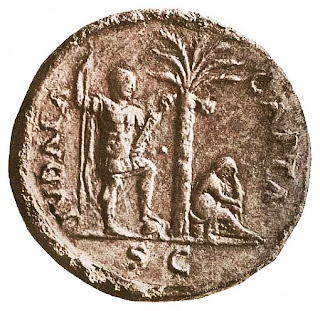
However, the broken figure of Synagoga works also as an allegory of the lost country of the (then) apatrid Jews. Her body language is not accidentally reminiscent of that in "IUDAEA CAPTA".
Far from being a fixed figure,[4] Synagoga undergoes a number of telling transformations as a visual motif in Western art:
1. Synagoga is a witness at the base of the Crucifixion.
2. Synagoga is depicted as blind and loses her crown.
3. Synagoga is represented either with a demon or with her eyes covered by a snake, both revealing her "sinful" condition.
4. Ecclesia versus Synagoga
5. With the Living Cross imagery, Synagoga is literally stabbed to death.
6. The aftermath: Ecclesia's "victory" over Synagoga
Eventually, Ecclesia and Synagoga are replaced by two institutional symbols: the (Christian) Pope and the (Jewish) High Priest.
In turn, Ecclesia and Synagoga are exceptionally provided with the attributes of the Pope and the High Priest, respectively.
While meditating on Christian identity and self-understanding, M.C. Boys sees "Synagoga" mostly as an anti-Jewish motif. She writes a great deal about the blindness of Synagoga, yet gives a single example of her as being stabbed by the Living Cross. But there are many more in Europe. And God may well have more than one blessing to give, but the fact is that today, seventy years after the Shoah, the six-hundred years-old motif of Synagoga being stabbed by the Living Cross remains still visible and pretty intact in the Old Continent.
___
References
1. Helen Rosenau, Ecclesia et Synagoga, Jewish Virtual Library (after Encyclopaedia Judaica), 2008. See also W.S. Seiferth, Synagoge und Kirche im Mittelalter (1964); B. Blumenkranz, Juden und Judentum in der mittelalterlichen Kunst (1965); E. Roth, in: AWJD, 18:1 (1963); L. Edwards, in: JHSET, 18 (1958), 63–75; P. Hildenfinger, in: REJ, 47 (1903), 187–96. See also Ecclesia, Synagoga and The Fallen Crown, Jewish Heritage Online Magazine.
2. Friends on the Way: Jesuits Encounter Contemporary Judaism, ed. Thomas Michel, S.J., Fordham UP, 2007. ISBN 0823228126 and 978-0823228126. The largest order of religious in the Roman Catholic Church, the Society of Jesus has been at the forefront of the Church's efforts at dialogue across religions. Understanding and improving relations between the Church and the Jewish people has been a major focus of the Holy See and the Society of Jesus for many years. This book, the fruit of a major conference on the history, nature, and dynamics of relations between Jesuits and contemporary Jewish life, brings together a rich, wide-ranging selection of essays by Jesuit scholars and pastoral leaders, a leading Jewish studies scholar,and a leading rabbi. Drawing on a variety of approaches in historical and constructive theology, literary criticism, and spirituality, the contributors explore historical, philosophical, theological, cultural, and institutional themes--from Ignatian perspectives on Halakhic spirituality and the role played in Jesuit history by Jews forced to convert to Christianity to Jesuit perspectives on Hannah Arendt, Abraham Joshua Heschel, and Harold Bloom. The ten papers in this volume were prepared for the Third International Colloquium of Jesuits in Jewish-Christian Dialogue held in 2005 at Zul, Switzerland. Thomas Michel, S.J., is Secretary for Interreligious Dialogue of the Society of Jesus in Rome and Ecumenical Secretary of the Federation of Asian Bishops' Conferences.
3. Ecclesia and Synagoga: A Medieval Artistic Vision Updated for the 21st Century, The Grinnell Magazine, Spring 2008.
4. See L'Église et la Synagogue and Les juifs dans l’art chrétien médiéval.
ECCLESIA ET SYNAGOGA, the name given to the symbolic representations in Christian art of the Middle Ages of the victorious Church and defeated Synagogue, symbolizing the triumph of Christianity. The representation is often found in medieval Christian manuscript art. It also became a conventional decoration in many medieval churches, especially in France, England, and Germany, and took the form of two graceful female figures, usually on the outside of the building. The Church is shown erect and triumphant, bearing a cross; the Synagogue is usually blindfolded and dejected, bearing a broken staff and sometimes decorated with the Tables of the Ten Commandments symbolizing the Old Testament. The best known statues of this type are on the exterior of the cathedrals of Strasbourg and Bamberg. They are also found in Rheims, Paris, and Bordeaux. In England, they figure, generally in a mutilated condition, in Rochester, Lincoln, Salisbury, and Winchester.[1]
 |
| Crucifixion with Ecclesia et Synagoga Notre-Dame des Douleurs, Marienthal, Alsace |
The representation of the blindfolded synagogue was paradoxically reflected even in Jewish manuscript art: as for example in the miniature of the blindfolded Torah with her spouse, the People of Israel, in a 14th-century manuscript prayer book (Hamburg, Cod. Lev. 37; possibly having a symbolic meaning, representing the Torah and the People of Israel).[1]
2. The Twenty-First-Century Pair
Has God Only One Blessing?
"Having at last realized that God has more than one blessing, we must widen the stakes of our tent in bold yet careful ways" —Mary C. Boys (p. 10).
In medieval art and architecture, Ecclesia and Synagoga were the symbolic representations of the Christian and Jewish faiths, portrayed by two female figures. Ecclesia, representing the Christian church, was proud and triumphant, with crowned head held high and bearing the cross. By contrast, Synagoga, representing Judaism, was shown downcast and forlorn in her defeat, bearing broken tablets and blindfolded—illustrating her blindness to the "truth" of the New Testament. Many European cathedrals bear the statues of Ecclesia and Synagoga, and they are depicted in stained glass as well.
Mary C. Boys, author of Has God Only One Blessing? Judaism as a Source of Christian Self-Understanding (New York and Mahwah, New Jersey: Paulist Press/Stimulus Books, 2000), found this representation troubling. She commissioned a new artwork to accompany her book. The new Ecclesia and Synagoga also appears on the cover of Friends on the Way: Jesuits Encounter Contemporary Judaism, ed. Thomas Michel, S.J. (Fordham UP, 2007).[2] This interpretation by sculptor Paula Mary Turnbull, S.N.J.M., offers "a new depiction of Ecclesia and Synagoga, where both stand tall as representations of their faith communities."[3]
 |
| Mary C. Boys argues that if God has more than one blessing, then Christians must fashion new images of Synagoga and Ecclesia. In these sculptures by Paula Mary Turnbull, SNJM, Ecclesia and Synagoga are depicted as partners in witnessing to and working for the Reign of God. Photo by Lynn Saville |
Further Research
Wikipedia: Ecclesia and Synagoga
Nina Rowe, The Jew, the Cathedral and the Medieval City: Synagoga and Ecclesia in the Thirteenth Century, Cambridge: Cambridge UP, 2011. In the thirteenth century, sculptures of Synagoga and Ecclesia – paired female personifications of the Synagogue defeated and the Church triumphant – became a favored motif on cathedral façades in France and Germany. Throughout the centuries leading up to this era, the Jews of northern Europe prospered financially and intellectually, a trend that ran counter to the long-standing Christian conception of Jews as relics of the pre-history of the Church. In The Jew, the Cathedral and the Medieval City, Nina Rowe examines the sculptures as defining elements in the urban Jewish-Christian encounter. She locates the roots of the Synagoga-Ecclesia motif in antiquity and explores the theme’s public manifestations at the cathedrals of Reims, Bamberg, and Strasbourg, considering each example in relation to local politics and culture. Ultimately, she demonstrates that royal and ecclesiastical policies to restrain the religious, social, and economic lives of Jews in the early thirteenth century found a material analog in lovely renderings of a downtrodden Synagoga, placed in the public arena of the city square.
Offers studies of the major Gothic cathedrals of Reims, Bamberg and Strasbourg.
A novel exploration of the Synagoga-Ecclesia motif in relation to imperial Roman artistic conventions.
Considers the popularity of the Synagoga-Ecclesia theme as a response to the Jewish-Christian interactions at the time.
Contents: Part I. Imagining Jews and Judaism in Life and Art: 1. The Jew in a Christian world: denunciation and restraint in the age of cathedrals 2. Ecclesia and Synagoga: the life of a motif Part II. Art and Life on the Ecclesiastical Stage – Three Case Studies: Introduction to Part II: nature, antiquity and sculpture in the early thirteenth century 3. Reims: 'our Jews' and the royal sphere 4. Bamberg: the empire, the Jews and earthly order 5. Strasbourg: clerics, burghers and Jews in the medieval city.
Review: "Rowe's approach to her work is impressively versatile, drawing historical, textual, and material evidence into synthesis with formal and stylistic observations to walk the line attentively between the worm's-eye and the bird's-eye view of her subject. The breadth and soundness of the resulting book will interest a wide range of scholars in fields from art history and Jewish studies to theology, anthropology and beyond." -Pamela A. Patton, The Medieval Review
Imagining the Self, Imagining the Other: Visual Representation and Jewish-Christian Dynamics in the Middle Ages and Early Modern Period, ed. Eva Frojmovic, Leiden: Brill, 2002. ISBN 9004125655
Mary C. Boys, Has God Only One Blessing? Judaism as a Source of Christian Self-Understanding, New York and Mahwah, New Jersey: Paulist Press/Stimulus Books, 2000. ISBN 0-8091-3931-6
Quotations from Has God Only One Blessing?
• Christian iconography of the Middle Ages provides a vivid image of rivalry in the figures of "Synagoga" and "Ecclesia", two representative women who graced many a cathedral, chapel, and Book of Hours in sculpture, woodcut, ivory relief, painting, and illumination from the ninth through the sixteenth centuries. Typically, they portray Ecclesia as standing erect and triumphant, symbol of the church of the victorious Christ. Synagoga, in contrast, is a conquered figure, symbol of Judaism's defeat and obsolescence. God has one blessing to give—and now Ecclesia, not Synagoga, received it.
Our history would have been radically different if we could have seen that God's relationship with one tradition does not diminish the sacredness of the other's. (p. 5)
• In Has God Only One Blessing?, p. 31, Boys considers the dual figures of Synagoga and Ecclesia in Christian iconography, noting that "for many Christians of the Middle Ages, that status of Judaism evoked images from Lamentations (1:1; 5:16-17):
How lonely sits the city
that once was full of people!
How like a widow she has become,
she that was great among the nations!
She that was a princess among the provinces
has become a vassal.
The crown has fallen from our head;
woe to us, for we have sinned!
Because of this our hearts are sick,
because of these things our eyes have grown dim.
• Synagoga symbolizes an obsolescent Judaism (p. 33).
• Other representations of Synagoga, particularly in the Late Middle-Ages, present a more contemptible figure. For example, in a fifteenth-century portrayal of the crucifixion, Ecclesia holds a chalice to receive the blood from the pierced heart of Jesus, whereas Synagoga turns away from him, in the clasp of a devil who rides atop of her neck and blinds her to the Christ by covering her eyes. The association with the devil evokes a malevolent Synagoga. A fresco entitled Living Cross (ca. 1475-80) by Thomas von Villach in a village church of Thörl situates Synagoga to the left of Christ; blind, she rides a gravely wounded donkey (an emblem of stupidity and stubbornness), and is pierced by a hand growing out of the crossbeam. In her own hand she holds a goat's head, symbol of the outmoded sacrificial cult of the 'Old' Testament (Boys, p. 35).
• If God has more than one blessing, then we need to fashion new images of Synagoga and Ecclesia. The figures of Synagoga and Ecclesia commissioned for this book portray a new relationship between church and synagogue. Each exists in her own integrity and vitality. Both are recipients of God's blessing, both true ways to God. They are partners in witnessing ti and working for the reign of God.
The images of Jews and Christians as partners in witness and work is a new vision. It reverses nearly two thousand of church teaching and popular religiosity. (p. 6).
 |
| Turnbull, Synagoga and Ecclesia, c. 2000 |
• Ecclesia will stand in right relation to Synagoga only when we Christians remember how earlier renditions of these figures imaged a defeated Judaism and a triumphal church, and repent of the way in which Christianity distorted Judaism (p. 278).
 |
| Mary C. Boys argues that if God has more than one blessing, then Christians must fashion new images of Synagoga and Ecclesia. In these sculptures by Paula Mary Turnbull, SNJM, Ecclesia and Synagoga are depicted as partners in witnessing to and working for the Reign of God. |
Review, by Ruth Langer (Boston College, USA).
The many medieval depictions of Ecclesia triumphant and Synagoga defeated clearly haunt Mary Boys as symbols of all that has been — and continues to be — wrong in the relations between Jews and Christians. Her search for a corrective to this sinful understanding drives her new book, to the point that she accompanies the book with a commissioned artwork, a new depiction of Ecclesia and Synagoga where both stand tall as representations of their faith communities. An essay on the symbolism embedded in these new figures will have to be reserved for a different venue, but it must be noted here that rather than looking at defeated Synagoga in triumph, the new Ecclesia, while still standing in relationship to her sister (marked by their similar styles of dress and hair), walks with her sister in parity and friendship as they together move forward.
As I read Boys’ book, I felt not only that Synagoga was being given the opportunity to walk alongside her sister, but that she was being invited to look over her sister’s shoulder as well. While Boys has written her book as a Christian educator for a Christian audience, much of what she writes needs to be known by the Jewish community as well. Boys’ task in this book is two-pronged: to translate much of the important scholarly work on issues pertinent to the Jewish-Christian relationship into terms more accessible to non-experts in the field; and to push forward the process of ending supersessionist teachings and their consequences in lived Christian life. Throughout the book, Boys is forthright and honest; nothing is honey-coated. To those who would point to the great strides taken to improve Jewish-Christian relations in the past decades, she cites instance after instance where, in spite of official pronouncements, anti-Jewish supersessionist sentiments still appear regularly in liturgy and educational materials.
Indeed, Boys is convinced that the first critical task is precisely sensitization to the anti-Jewish assumptions that infuse Christian teachings. Her book literally unfolds, beginning with stories designed to raise these sensitivities, and moving from there ever deeper through the tasks necessary to address the consequent issues. Once one is aware of Christian anti-Judaism, Boys suggests, one must confront and acknowledge the full and gory history of Christian anti-Judaism and its consequences (Ch. 4). This knowledge creates an imperative for discovering new non-supersessionist ways to tell the Christian sacred story (Ch.5). But a responsible retelling must be grounded in a sophisticated understanding of the worlds of Jesus and the early Church (Part III, Chs. 6-10). Only after presenting a synthesis of contemporary historical scholarship does Boys begin explicitly to discuss various areas where this scholarly task needs to be integrated into actual contemporary church practice and teaching. Her chapters on Scripture, Liturgy, and the symbolism of the cross (Part IV, Chs. 11-13) provide fine examples of the types of challenges that Christianity needs to confront. However, they are just examples. A comprehensive discussion of similar depth would require several more books. Boys concludes with an analysis of various official church pronouncements about Jews and Judaism and a brief programmatic discussion on how the churches might meet the challenge of bridging the gap between official policy and the minds and hearts of the community (Part V, Chs. 14-15).
As a Jewish Studies professor at Jesuit university, I found myself musing constantly as I read this book about how it could be integrated into my courses at Boston College. Not only is Boys’ writing sufficiently free of jargon to be (for the most part) accessible to the non-specialist reader, but she demonstrates in multiple ways how an encounter with the "other," most significantly the Jewish "other," preferably in person but even through books, is critical to the theological formation of a faithful Christian. As a Jewish professor, I can create this encounter, but articulating its goals without preaching has been challenging. One solution is the model of co-teaching developed for interreligious learning by Mary Boys and Sara Lee. But lacking that possibility, Boys’ book may very well prove to provide that missing voice.
Is Boys’ book perfect? Any synthetic and accessible presentation of many complex fields of scholarly inquiry is bound to have some problems. Although Boys acknowledges many expert readers in her introduction, I still find myself with a list of minor quibbles about her portrayal of Judaism. For instance, the Samaritan and the Essene rejections of the Jerusalem Temple were not really comparable, as the Samaritans rejected both place and cult while the Essenes apparently rejected just the cultic practices of their contemporary Jerusalem priesthood. (p. 109)
While Boys correctly points to the centrality of the Temple and its sacrifices in Jewish life of the period and offers a sophisticated if necessarily brief discussion of their meaning (pp. 117 ff.), she concludes with Gerd Theissen’s interpretation of Jesus’ relationship to the Temple. This skews her otherwise balanced portrait. Theissen suggests that the primary function of Temple ritual was to forgive sins. Although this was unequivocally one role of the Temple, the focus of the Jewish liturgical response to the Temple’s destruction suggests that this function was not central. The key prayers of the rabbinic verbal worship system correspond to the covenant-maintaining mandatory daily and festival sacrifices, not to the more voluntary and incidental sin offerings. Themes of sin and forgiveness drive rabbinic liturgy only one day a year, on Yom Kippur. But these issues and others like them are minor in the scope of Boys’ work; we could argue and discuss them, but the outcome would not change her book.
My only major "quibble" is more fundamental. While the synagogue became an increasingly important institution after the destruction of the Temple, Jews never designated their community by its name because it represents just a single facet of Jewish communal life. Instead, Jewish self-identification, from biblical times, has been as Israel, the name God gave our ancestor Jacob and the name of the land that Jacob’s descendents call home. Medieval theologians projected the Christian ideal of religious community embodied in Ecclesia onto her sister Synagoga, ignoring (or rejecting) precisely these familial/ national and geographical elements of Jewish theological self-identification and leaving only the religious. Boys, with her sensitivity to the symbolic, has done so much to make the attitudes embodied in the medieval depictions repugnant to her readers. I would encourage her to take one more symbolic step: eliminate the name "Synagoga" and call Ecclesia’s sister "Israel."
The Symbolic Step
Langer's last idea is important and for a number of reasons. Initially, the supersessionist criticism expressed through the contrasting pair of allegories targeted chiefly Judaism as Institution (hence the name of the figure, Synagogue).
 |
| Ecclesia and Synagoga as Institutions The Crucifixion, with Ecclesia and Synagoga fresco, 1882 Ehemalige Klosterkirche Sankt Ägidius, Kleincomburg |
However, the broken figure of Synagoga works also as an allegory of the lost country of the (then) apatrid Jews. Her body language is not accidentally reminiscent of that in "IUDAEA CAPTA".
 |
| The Crucifixion, with Ecclesia and Synagoga Europe, 19th century |
 |
| "IUDAEA CAPTA" Allegoric Roman coin with a captive Jewish woman sitting under a palm tree Despite its minute size within the empire, suppression of the Great Jewish Revolt of 66-70 CE. required a massive Roman military force. |
Far from being a fixed figure,[4] Synagoga undergoes a number of telling transformations as a visual motif in Western art:
1. Synagoga is a witness at the base of the Crucifixion.
 |
| The Crucifixion, with Ecclesia and Synagoga Carolingian ivory, Metz, 860 CE. |
2. Synagoga is depicted as blind and loses her crown.
 |
| Ecclesia et Synagoga Liebfrauenkirche, Trier, Germany, 1250 |
3. Synagoga is represented either with a demon or with her eyes covered by a snake, both revealing her "sinful" condition.
 |
| Ecclesia with church and Synagoga with demon Cathedral of Notre-Dame, Chartres, 13th century |
 |
| Crucifixion, with Ecclesia and Synagoga Bible historiée, Haguenau, Germany, 15th century |
 |
| Ecclesia et Synagoga St. Seurin, Bordeaux, France, 1264 |
 |
| Synagoga Notre-Dame de Paris, restored 1845-64 |
 |
| Synagoga Notre-Dame, Paris, restored 1845-64 |
4. Ecclesia versus Synagoga
 |
| Combat riding tournament: Ecclesia vs. Synagoga Wood carving. Cathedral of Erfurt, Germany, 1400-10 |
5. With the Living Cross imagery, Synagoga is literally stabbed to death.
 |
| The Living Cross fresco, c. 1400 Cathedral of San Petronio, Bologna |
 |
| Ecclesia et Synagoga stained glass, 1414-67 Johanneskirche, Werben, Germany |
 |
| Follower of Giovanni da Modena Croce brachiale, fresco, c. 1450 Cappella di S. Croce, Mondovì Piazza, Torino |
 |
| Thomas von Villach Lebendes Kreuz fresco, c. 1475-80 Pfarrkirche St Andreas, Thörl Maglern, Austria |
 |
| Cretan School, Living Cross, 16th century Musée des Beaux-Arts, Beaune |
 |
| Benvenuto Tisi da Garofalo The Living Cross with Ecclesia and Synagoga, c.1530 Hermitage Museum, St Petersburg |
6. The aftermath: Ecclesia's "victory" over Synagoga
 |
| Initial "Q" Homily of Bede of Verdun, France, 13th century |
Eventually, Ecclesia and Synagoga are replaced by two institutional symbols: the (Christian) Pope and the (Jewish) High Priest.
 |
| Master of St Veronica Christ on the Living Cross, Germany, 1420-30 Art Institute of Chicago |
 |
| Hispano-Flemish Anonymous The Fountain of Grace or The Triumph of the Church over the Synagogue, 1450 Museo del Prado, Madrid |
In turn, Ecclesia and Synagoga are exceptionally provided with the attributes of the Pope and the High Priest, respectively.
 |
| Ecclesia et Synagoga Church of San Moisè (Chiesa di San Moisè), Venice, 18th century |
While meditating on Christian identity and self-understanding, M.C. Boys sees "Synagoga" mostly as an anti-Jewish motif. She writes a great deal about the blindness of Synagoga, yet gives a single example of her as being stabbed by the Living Cross. But there are many more in Europe. And God may well have more than one blessing to give, but the fact is that today, seventy years after the Shoah, the six-hundred years-old motif of Synagoga being stabbed by the Living Cross remains still visible and pretty intact in the Old Continent.
 |
| Baptismal font, St. Mary's Church, Prestbury, UK. The tree of Ecclesia is in bloom while the tree of Synagoga is dead; Ecclesia is the sun, the moon over Synagoga only reflects the light of the sun. |
___
References
1. Helen Rosenau, Ecclesia et Synagoga, Jewish Virtual Library (after Encyclopaedia Judaica), 2008. See also W.S. Seiferth, Synagoge und Kirche im Mittelalter (1964); B. Blumenkranz, Juden und Judentum in der mittelalterlichen Kunst (1965); E. Roth, in: AWJD, 18:1 (1963); L. Edwards, in: JHSET, 18 (1958), 63–75; P. Hildenfinger, in: REJ, 47 (1903), 187–96. See also Ecclesia, Synagoga and The Fallen Crown, Jewish Heritage Online Magazine.
2. Friends on the Way: Jesuits Encounter Contemporary Judaism, ed. Thomas Michel, S.J., Fordham UP, 2007. ISBN 0823228126 and 978-0823228126. The largest order of religious in the Roman Catholic Church, the Society of Jesus has been at the forefront of the Church's efforts at dialogue across religions. Understanding and improving relations between the Church and the Jewish people has been a major focus of the Holy See and the Society of Jesus for many years. This book, the fruit of a major conference on the history, nature, and dynamics of relations between Jesuits and contemporary Jewish life, brings together a rich, wide-ranging selection of essays by Jesuit scholars and pastoral leaders, a leading Jewish studies scholar,and a leading rabbi. Drawing on a variety of approaches in historical and constructive theology, literary criticism, and spirituality, the contributors explore historical, philosophical, theological, cultural, and institutional themes--from Ignatian perspectives on Halakhic spirituality and the role played in Jesuit history by Jews forced to convert to Christianity to Jesuit perspectives on Hannah Arendt, Abraham Joshua Heschel, and Harold Bloom. The ten papers in this volume were prepared for the Third International Colloquium of Jesuits in Jewish-Christian Dialogue held in 2005 at Zul, Switzerland. Thomas Michel, S.J., is Secretary for Interreligious Dialogue of the Society of Jesus in Rome and Ecumenical Secretary of the Federation of Asian Bishops' Conferences.
3. Ecclesia and Synagoga: A Medieval Artistic Vision Updated for the 21st Century, The Grinnell Magazine, Spring 2008.
4. See L'Église et la Synagogue and Les juifs dans l’art chrétien médiéval.
Resources
• Interfaith Dialogue in Our Time
• Synagoga and Ecclesia in Our Time
• Arte y Diálogo Interreligioso
• Ayer y Hoy
• Album Ecclesia et Synagoga
• Wikimedia Pic


