3.4.13

La Crucifixión Blanca


El Papa Francisco ha indicado La Crucifixión Blanca como su pintura favorita.* A continuación exploramos el cuadro de Chagall, su contexto histórico e importancia en materia interreligiosa.


Marc Chagall, La Crucifixión Blanca, 1938
Art Institute of Chicago

La Crucifixión Blanca es un cuadro que a primera vista expresa la agonía de Jesús así como el dolor del pueblo judío.

En el óleo hoy preservado en el Instituto de Arte de Chicago central es la figura de Jesús crucificado. Sus ojos se hallan cerrados. Desde su posición única en la cruz, la figura Jesús comunica no poca serenidad.[1]

En la obra, la figura de Jesús no es presentada con el paño común a conocidas Crucifixiones sino un manto ritual judío para orar (talit).

Sobre la cruz figura la inscripción "INRI" (abreviatura de Iesus Nazarenus Rex Iudeorum), expresión de doble-filo escogida por los romanos para humillar tanto a Jesús como a los hebreos. Significativamente, ambos -de un modo u otro- comparten la condición de estar sometidos al yugo pagano. Con todo, en la pintura de Chagall, las mencionadas iniciales latinas son seguidas por su versión in extensum, a la que Chagall inscribe recurriendo al uso de caracteres hebreos tradicionales (Iéshu Hanotzrí Mélej Haiehudim).

En la historia del arte, Chagall, artista judío, pinta a Jesús de Nazaret con una compasión que conmueve y lo reconoce, ante todo y por sobre todo, como hijo de la nación hebrea.[2]

El Jesús de Chagall no posee corona de espinas ninguna, mas algo semejante a un turbante parece haberla reemplazado. Tal elemento conecta implícitamente a Jesús con los profetas de la Tierra Santa. En efecto, en el arte europeo pre-moderno, el turbante fue empleado persistentemente como atributo distintivo de los profetas hebreos.

La figura de Jesús en la cruz es presentada por Chagall con sensibilidad. Grande es el respeto e innegable la compasión del maestro de Vitebsk para con Jesús. Según lo pintado por Chagall claros están el origen, la integridad e inocencia de Jesús, a quien el pintor ha representado como un ser puro e iluminado. Un haz de luz blanca desciende sobre la cruz e ilumina la singular figura del Nazareno.

La escena representada por Chagall muestra una Europa en tinieblas y la luz que desciende sobre Jesús es única en todo el cuadro. Emanando desde el firmamento, ella lo presenta como un ser extraordinario, el que finalmente vencerá a la muerte cuando la Resurrección.

El título de la obra de Chagall tiene su origen precisamente en esa luz de esperanza.[3]

Chagall pintó esta obra en 1938, el mismo año de la Kristallnacht o Noche de los cristales rotos en Austro-Alemania, pocos meses antes de iniciarse el exterminio sistemático de prácticamente toda la población judeo-europea, así como la destrucción de su facetada cultura.

Chagall era parte de ella y ella era parte de Chagall.

Porque suya era la cultura del shtétl y del Yiddish, de los estudios y de los casamientos en la aldea, de las papas y de los candelabros, de las parejas y de los rabinos, de talentos y de negocios, de cabritos y de somovares, de sueños y de "ya sé que estoy soñando pero por favor no me despiertes" -en fin, de pequeñas eternidades y de pógroms en abundancia.

No por casualidad es Chagall además autor de aquellos violinistas que desde su obra continuan aún hoy ejecutando melodías klétzmer desde el precario equilibrio que presupone el andar haciéndolo precisamente donde lo hacen, allí, sobre el tejado.

Una rima folclórico-tradicional perteneciente a la cultura Yiddish, ésa a la que Chagall mismo perteneció y de la que sólo algunos fragmentos hoy sobreviven, afirma que el mundo es en su totalidad un puente muy estrecho y [al encontrarse ante ese puente tan angosto que es la vida y estar uno a punto de cruzarlo] lo fundamental es no asustarse.[4]

En su autenticidad, la obra plástica de Chagall es expresión de coraje y pertenece además a una cultura guiada por la tradición, el estudio y la esperanza.

En 1937, con el propósito de segregar los poblados europeos y de sabotear la libre expresión (que es el fruto fundamental del arte moderno), los nazis exhibieron obras de Chagall entre lo que ellos calificaron como ejemplos de arte "degenerado" (Entartete Kunst).[5]

La Crucifixión Blanca fue realizada por Chagall sólo un año después.[6]

En la Crucifixión Blanca, a ambos lados de la cruz, pueden verse las figuras preocupadas e incluso agitadas de algunos judíos de la Europa oriental. Sobre la izquierda del cuadro irrumpen los revolucionarios comunistas con sus banderas rojas, mientras que el fuego consume las casas y la comunidad hebrea intenta alejarse del Viejo Continente en un sobrecargado botecito; sobre el lado derecho de la obra la situación tampoco es mejor: un nazi profana y destruye una sinagoga, y también ella arde en llamas.

La figura de Jesús es por otra parte, es también iluminada por un candelabro, conocido en hebreo como menoráh (lámpara, luminaria).

Cruz y menorá coexisten también en el Mausoleo Dorrego-Ortiz Basualdo (que se encuentra en el Cementerio de la Recoleta). Chagall presumiblemente pudo no haber conocido ese conjunto escultórico italo-porteño, pero a Francisco Bergoglio, alguna vez Arzobispo de la Ciudad de Buenos Aires, casi con toda seguridad el mismo no lo debe haber dejado para nada indiferente.


Al pie de cruz, la fe personificada vierte aceite en la menorá.
Dubois y Villa, Mausoleo Dorrego-Ortiz Basualdo, fines siglo XIX o principios siglo XX. Cementerio de la Recoleta, Ciudad de Buenos Aires, República Argentina

Pero volvamos a Chagall. Al yuxtaponer a Jesús con los judíos de la Europa oriental, ¿Chagall no reinventa acaso la historia? Tal vez. Porque muy posible es el que Chagall haya pintado aquí la experiencia de algún creyente que no fuese indiferente frente aquello que les sucedía a los judíos europeos en el año 1938: la destrucción sistemática de su mundo, de su cultura, de sus vidas.

Entre las figuras representadas en la Crucifixión Blanca se encuentra un hombre judío que parece haber logrado rescatar la Torá y quien a su vez, con tristeza, avanza, pero sin quitar la vista ni de Jesús en la cruz ni de la sinagoga en llamas. Delante de ese hombre puede verse otro en azul, portando un cartel otrora escrito en alemán e identificándolo como judío. Hijo del pueblo de la memoria, Chagall no pudo sino registrar todo esto para recordárselo al espectador una y otra vez.[7]

Jesús ha sido marcado por los romanos (INRI) y, análogamente, también lo ha sido el recién mencionado judío por los nazis ("Ich bin Jude"). Históricamente, ambos rótulos fueron concebidos con el mismo propósito: humillar a las víctimas. Con todo, en la pintura de Chagall dichos rótulos revierten tal intención y solo dejan al descubierto el sinsentido y la banalidad del mal.[8]

El hombre con la bolsa que también figura en la Crucifixión Blanca es usual en la imaginería de Chagall. Podría ser una triste alusión al otrora muy popular mito europeo del Judío Errante, aunque en este caso probablemente simbolice además los permanentes traslados de la comunidad hebrea en ese duro período.

La cruz, en particular aquella en las escenas de la Crucifixión, fue durante mucho tiempo percibida por el siempre minoritario pueblo judío como un símbolo de opresión. Sin embargo, en La Crucifixión Blanca Chagall reformula tal percepción y representa el dolor como un factor común tanto a Jesús como al pueblo hebreo.

Chagall fue un pintor profundamente espiritual.

Y, a diferencia de no poca gente de su época, Chagall mantuvo una visión amplia y esperanzada.

Chagall respetó a su prójimo; es más, probablemente incluso le deseó el bien.

Humano ante todo y por sobre todo, Chagall amó tanto la tradición como la innovación.

Es cierto que Chagall desarrolló un tipo de Jesús específicamente judío.[9] Con todo, la contribución real de Chagall reside en su recuperar al Jesús hebreo, sin por ello abandonar él su propio judaísmo (el de Chagall), para llegar así finalmente a hermanarse con tanto con los judíos como con los cristianos.

Fuera de lugar estaría entonces el tildar al arte de Chagall como "arte judío", ya que el suyo de hecho sí lo es, pero solo hasta cierto punto. Dado que Chagall va más allá de su propio judaísmo o bien, si se quiere, crea un verdadero díalogo con el cristianismo. Conviene recordar que, por sobre todas las cosas, Chagall fue un maestro creador y que su arte se origina en contexto específico y particular, pero sin olvidar que Chagall fue también siempre consciente del plano universal al que su obra debía aspirar y que es precisamente por ello logró ir más allá del mencionado contexto o lote que en la vida le tocó.

Haciendo referencia directa a ciertos momentos tremendos en la historia de la humanidad, la pintura de Chagall funciona como si fuese una plegaria u oración dirigida a Dios, una que a su manera llega a expresar -en términos visuales- las palabras de San Pablo: "Hermanos míos, esos de mi propio pueblo, la gente de Israel. De ellos es la adopción como hijos [del Señor], la gloria divina, los pactos, la ley, las oraciones a Dios desde el Templo y el contar con Sus promesas. Suyos son los patriarcas, y desde ellos es trazado el linaje humano del Cristo" (Romanos, 9: 1-5).

En una sola pintura Chagall ha logrado unir aquello que por muchísimos siglos comunidades enteras concibieron sólo en términos de segregación y antagonismo.

Ecclesia et Synagoga
Estrasburgo en la Edad de Piedra o la política del rancho aparte

Brujas en alta: "chicas, sobre todo no intercambien ningún atributo."

Burgos con la unidad religiosa ya bien implantada: concurso de belleza

La Ciudad Luz: "manténgase por favor cada una en su respectivo nicho"

Rochester en cápsulas: "preservando el patrimonio heredado"

Los comitentes, financistas e incluso autores de los cinco ejemplos precedentes indudablemente poco y nada sabían de la prédica de San Pablo y sus estimulantes analogías arbóreas. Caso contrario no hubiesen perdido ni su tiempo ni sus fuerzas fabricando toneladas de innecesarios alardes narcisistas por toda Europa. Citemos a San Pablo una vez más:

Y si la raíz es santa, también lo son las ramas. Pero si algunas de las ramas fueron desgajadas, y tú, siendo olivo silvestre, fuiste injertado entre ellas y compartes ahora la savia nutricia que te llega desde la raíz del olivo, no seas arrogante para con las ramas. Y si te jactas, sabe que no sustentas tú a la raíz, sino que es la raíz la que te sustenta a ti (Romanos, 11: 16-20).

Agreguemos una última reflexión acerca de la relación entre el árbol de navidad y lo que la gente en él percibe. Si se fija la atención en los (a menudo deslumbrantes) ornamentos del árbol de navidad, acaso se corra el riesgo de olvidar que la tradición original (pagana) involucraba el que al árbol a ser empleado se le amputase desde el vamos su raíz. ¿Y no es un árbol sin raíz acaso un árbol condenado a muerte?


El olivo en flor: tiene raíz.

Claro que eso sólo se comprende con los años. Así, casi parafraseando a San Pablo, cuando por ejemplo Francisco Luis Bernárdez escribe uno de sus mayores sonetos, concluye sus versos recordándonos que lo que el árbol tiene de florido vive de aquello que tiene sepultado.

Es precisamente en este sentido que la Crucifixión Blanca de Chagall funciona como un verdadero puente entre culturas.

Tal como sucede con el título de un óleo pintado por Gauguin en 1897, también la Crucifixión Blanca tiende a interrogarnos acerca de dónde venimos, qué somos, y a dónde vamos.[10]

Como trabajo estimulante para el diálogo interreligioso, La Crucifixión Blanca constituye un puente entre creencias, así como también un puente entre creyentes.

El cuadro de Chagall no se centra solo en el sufrimiento, sino que expresa además la vulnerabilidad del hombre y su real necesidad de creer en Dios.

Dicho en otras palabras, caminante hay camino.[11]

Dada la originalidad y el profundo sentir espiritual que como obra conlleva, La Crucifixión Blanca de Marc Chagall es un cuadro extraordinario, una obra maestra que brilla y se destaca entre las obras más significativas del arte occidental.


Acerca de cuál es el primero de los mandamientos, Jesús responde: "El primero es: « Escucha Israel, el Señor, nuestro Dios, es el único Señor, y amarás al Señor tu Dios con todo tu corazón, con toda tu alma, con toda tu mente y con todas tus fuerzas. » El segundo es: « Amarás a tu prójimo como a ti mismo » [Levítico 19, 18]. No existe otro mandamiento mayor que éstos" (Marcos 12, 29-31).

Notas
* Jorge Mario Bergoglio, entrevistado por Francesca Ambrogetti y Sergio Rubin, El Jesuita, Editorial Vergara, 2010, p. 196; véase también Nicolás de la Carrera, Crucifixión Blanca, Peregrinos, 14.3.2013, y Mario Giliardoni, La pintura preferida del Papa Francisco, Trastienda Plus, 5.4.2013.
1. La tonalidad amarilla del cuerpo del Nazareno tiene su referente visual en El Cristo Amarillo de Paul Gauguin, óleo de 1889 que tiene que ver no tanto con la idea de representación sino con la libertad del pintor moderno en su uso de la forma y el color. Además a ello debe agregársele el conocimiento y práctica del fauvismo por parte de Chagall. Véase, por ejemplo, Marc Chagall.
2. Hubo otros pintores judeo-europeos que precedieron a Chagall y también pintaron a Jesús, pero lo hicieron representando las tradicionales escenas en las que los judíos tienen contacto con la prédica de Jesús en los tiempos bíblicos, ya sea en el Templo de Jerusalén o en la Sinagoga de Cafarnaúm. Tal es el caso de pintores tales como Maurycy Gottlieb y Max Liebermann quienes desarrollaron algo semejante a lo que hoy se denomina pintura histórica. Véase, por ejemplo, Gottlieb, Jesús Predicando, 1878-79 (Narodowy Museum, Varsovia); y Liebermann, Jesús a los 12 años en el Templo, 1878-79 (Kunsthalle, Hamburgo). Seis décadas más tarde, el tema y modo de operar de Chagall son considerablemente distintos ya el pintor no focaliza sobre las posibles diferencias entre Jesús y los judíos sino en aquello que tienen en común.
3. Iker Landeta, Análisis de La Crucifixión Blanca, Radio EUSKADI, 18.9.2012. La audición aporta ideas valiosas pero lamentablemente incluye también inexactitudes e información errónea: pógrom no es exactamente sinónimo de exterminio étnico; en la pintura de Chagall no hay "violencia entrecomillada" sino que la Crucifixión de Jesús y la profanación y desacralización de la sinagoga son en sí mismos actos de violencia (sin comillas ningunas); la amenaza real que se ve en el cuadro no es la ortodoxia rusa de la época de los zares sino el ateismo de los comunistas; no todo lo imaginario es necesariamente fantasía ni ensueño ni surrealismo: el simbolismo en el arte existe desde la época del arte rupestre; con todo, sí es cierto que a través de su obra Chagall contribuyó a que la iconografía hebrea sea conocida a nivel universal.
4. El texto fue originalmente formulado por Nájman de Breslav, rabino de Ucrania en cuyas enseñanzas la alegría posee un papel fundamental.
5. Mariano Akerman, Arte "Degenerado", Documenta, 2.12.2012
6. El pintor se encontraba en ese entonces en Francia.
7. Esa fue su intención inicial, incluso si tiempo más tarde haya repintado y cubierto el área que exhibía dicha inscripción en alemán.
8. La expresión "banalidad del mal" pertenece a Hannah Arendt.
9. Ziva Amishai-Maisels, "The Jewish Jesus," Journal of Jewish Art, vol. 9, 1982, pp. 84-104; Depiction and Interpretation: The Influence of the Holocaust on the Visual Arts, Oxford: Pergamon, 1993, parte 2, capítulo 3; "Origins of the Jewish Jesus", en Complex Identities: Jewish Consciousness and Modern Art, Rutgers University Press, 2001, capítulo 4; y "Jesus as a Jew in Jewish Art," The Jerusalem Post, Christian edition, 16 April 2009.
10. El óleo de Gaugin pertenece a su período tahitiano y el título original de la obra es de inspiración mahorí siendo no obstante fue formulado por el pintor posimpresionista en francés: "D'où venons-nous? Que sommes-nous? Où allons-nous?"
11. Contrariamente a lo que predica Antonio Machado al escribir su "cuando de nada nos sirve rezar" y acompañarlo por un "caminante no hay camino sino estelas en la mar." Frente a esto, uno podría suponer que Machado jamás se enteró de la existencia de Biblia y menos que menos de sus contenidos. La experiencia vivida lleva a la conclusión de que no es para nada recomendable el andar viviendo "a la que te criaste".


El Mesías con Ecclesia y Synagoga
Vitral, Basílica de St Denis, Francia, siglo XII

2.4.13

The White Crucifixion


Marc Chagall, The White Crucifixion, 1938
oil on canvas, 154.3 x 139.7 cm
Art Institute of Chicago

The White Crucifixion is a painting that simultaneously conveys the suffering of Jesus of Nazareth and that of a Jewish community.

Central to Chagall's composition is the figure of Jesus on the cross. Notably, instead of a white piece of cloth, Chagall's Jesus presents a Jewish praying shawl.

Below the traditional "INRI" (abbreviation of Iesus Nazarenus Rex Iudeorum, expression chosen by the Romans and put on the cross in order to humiliate both the Nazarene and the Jews), Chagall added the meaning of the four Latin letters in full Hebrew characters.

In the History of Art, Chagall is among the first Jewish artists who painted Jesus, with compassion, and identifying the Nazarene as a son of the Hebrew nation.

Although crucified, Chagall's Jesus bears no crown of spines. The white turban on Jesus' head is an attribute that links the Crucified with the prophets from the Holy Land. In European art, the turban has often been used as a distinctive sign of a Hebrew prophet.

The figure of Jesus on the cross is rendered by Chagall with sensitivity. According to Chagall's image, there can be no doubt about Jesus' origin and integrity. Moreover, white light descends on the cross, illuminating the Nazarene.

Chagall painted this picture in 1938, a few years before the assassination of almost all the European Jewry.

In Chagall's Crucifixion, there are various stressed European Jews on both sides of the cross. On the left one can see the red flags of Communism, houses in flames, Jews trying to leave Europe in a boat; on the right a Nazi destroys a synagogue in Lithuania.

The figure of Jesus is also illuminated by a six-branched candelabrum.

The figures in the foreground include a Jewish man who advances carrying a Torah with him, yet simultaneously looking back, at Jesus on the cross and the synagogue in flames. Preceeding this man there is yet another one branded and bearing a placard in German that reads "Ich bin Jude", probably to remind the viewer of ordinary discrimination under the Nazi regime.[1]

Like Jesus, who has been branded by the Romans (INRI), another man has been labelled, although this time not by the Romans. Brutality is the common ground of both labellings and, historically made to humiliate the victims. Chagall's painting clearly shows the oppressor's inhumanity.

An additional, green man carrying a bundle that crosses the painting in the foreground also appears in other several works by Chagall. Perhaps is a Jewish wanderer from the Yiddish community or an emigré. Whatever the case, it also recalls the Wandering Jew coming from popular European myth and its anti-Semitic legends.

The cross, especially the one in the very scene of the Crucifixion, was often regarded as a symbol of oppression by the Jewish people, but in The White Crucifixion, Chagall reformulates this view, as he represents suffering as the common ground to both Jesus and the Jews.

While suffering is the theme of Chagall's painting, it is no secret that Chagall was a deeply spiritual man. Indeed, unlike many others,[2] Chagall was an open-minded person, being in love with both tradition and innovation.

It is sometimes said that Chagall developed the "Jewish Jesus" type. His real contribution, however, maybe was to have trascended the several traditional boundaries.

Presenting some of the darkest moments in history of humanity, Chagall's image implicitly recalls the words of St Paul: "my brothers, those of my own race, the people of Israel. Theirs is the adoption as sons; theirs the divine glory, the covenants, the receiving of the law, the temple worship and the promises. Theirs are the patriarchs, and from them is traced the human ancestry of Christ".[3]


Moreover, linking Judaism to Christianity, Chagall could also be evoking the ideas that "if the root is holy, so are the branches. If some of the branches have been broken off, and you, though a wild olive shoot, have been grafted in among the others and now share in the nourishing sap from the olive root, do not boast over those branches. If you do, consider this: You do not support the root, but the root supports you. [...] Do not be arrogant, but be afraid".[4]

The olive tree in bloom: has a root.
What the tree has in bloom is nourished by that which is buried.
Francisco Luis Bernárdez: Lo que el árbol tiene de florido vive de aquello que tiene sepultado.

Because of its originality and human dimension, The White Crucifixion is often considered to be a remarkable work of art and one of the most significant masterpieces that are preserved in the Art Institute of Chicago.


Notes
1. Jackie Wullschläger notes that two changes were made by Chagall to the work, the swastika on the armband of the Nazi burning the synagogue was overpainted as well as the words "Ich bin Jude" on the placard around the neck of another man (Chagall, 2008).
2. Indeed, the fine appearance of Chagall's Jesus has nothing to do with, for instance, the coarse look of Neave's stereotyped Jesus:

Richard Neave (University of Manchester), The Son of God, forensic reconstruction, broadcast on BBC, 2001. Feedback: “My only quibble would be that this face doesn’t have any soul in the eyes. In portraying the face of Christ each artist is expressing their own soul image, but this face does look a bit vacant” (Mary Farley, Society of Catholic Artists); “Unless you believe all first-century male residents of Israel to have looked identical, … the exercise in reconstruction is pointless” (Catherine Bennett, The Guardian).
3. Romans, 9: 1-5
4. Ibid., 11: 17-20


Further reading
• Ziva Amishai-Maisels, The Jewish Jesus (Jesus as a Jew in Jewish Art, April 2009), Documenta, 6.4.2013.


Comments received
A. Thanks! I have no idea of this painting by Chagall and its contents. Julia Meana
B. I like Chagall very much. He's an optimist in the middle of a sad world and he never abandons you there. Excellent text. Thanks, Mónica Ottino
C. It is always interesting to read the stuff you analize. Débora Sis
D. What a good article! I keep on thinking about how strong and wise are St Paul's words on the olive tree. Pancho Ottino
E. Marvellous. Thanks for this wonderful present. Eugenia Zabini
F. This text makes a difference. Congratulations. Jorge Bozzano
G. Thanks. This text is super-interesting. After having read it carefully, I've leart a lot. Saint Paul's words are impressive. Eddy Bull
H. Excelent analysis. Martiny Yaya
I. Intense. Most interesting. I've love it. Now I feel that we need to learn more about our Jewish-Christian culture, its origins and relationships, because most people forgets that Christianity was born frem Judaism. Reading your text gives one enthusiasm to do so. The text you've published is simply adorable. Mariana Figueroa Sánchez
J. Darling, what nice lines you have written. Also a most meaningful homage to professor Ziva Amishai-Maisels. Deby from Spring Hill said
K. Thank you for the article. All the best, Ziva Amishai-Maisels
L. Ah! Takes me back! Perhaps you could come back on a lecture tour? Dr Jenny Naseem
M. Most interesting! Claudia Itkin.

16.3.13

Jewish Art


Before Emancipation Jewish culture was dominated by the religious tradition of aniconism. As most Rabbinical authorities believed that the Second Commandment prohibited much visual art that would qualify as "graven images", Jewish artists were relatively rare until they lived in assimilated European communities beginning in the late 18th century.[1]

High Priest's breastplate
Jewish Encyclopedia, 1905-6

It should be noted however, that despite fears by early religious communities of art being used for idolatrous purposes, Jewish sacred art is recorded in the Tanakh and extends throughout Jewish Antiquity and the Middle Ages. The Tabernacle and the two Temples in Jerusalem form the first known examples of "Jewish art".

Rimon
Inscribed ivory pomegranate from Solomon's Temple
8th century BCE
The IL Museum, Jerusalem
This thumb-sized pomegranate is believed to be the only surviving relic from Solomon's Temple in Jerusalem. Around the shoulder of the pomegranate there is a carefully incised inscription in early Hebrew characters, part of which is broken off, which reads: "qodes kohanim I-beyt [yahwe]h". "Sacred donation for the priests of (in) the House of [Yahwe]h." Most probably "House of Yahweh" refers to the Temple in Jerusalem. The pomegranate was Solomon's favorite motif and decorated the capitals of the two freestanding columns at the entrance to the Temple in Jerusalem (1 Kings 7:21).

During the first centuries of the Common Era, Jewish religious art was created in regions surrounding the Mediterranean sea and included frescoes on the walls of sacred places such the Dura Europos Synagogue or the Jewish catacombs in Rome.[3] A Jewish tradition of illuminated manuscripts in at least Late Antiquity has left no survivors, but can be deduced from borrowings in Early Medieval Christian art. A number of luxury pieces of gold glass from the later Roman period have Jewish motifs. Several Hellenistic-style floor mosaics have also been excavated in synagogues from Late Antiquity in the Holy Land, and they present the signs of the Zodiac. Some, such as that at Naaran, show evidence of a reaction against images of living creatures around 600 CE. The decoration of sarcophagi and walls at the cave cemetery at Beit She'arim shows a mixture of Jewish and Hellenistic motifs. However for a period of several centuries between about 700 and 1100 CE there are scarely any survivals of identifiably Jewish art.

Khazar Rider and Prisoner
Gold relief from Atil, 850 CE.

Middle Age Rabbinical and Kabbalistic literature also contain textual and graphic art, most famously illuminated haggadahs such as the Sarajevo Haggadah, and other manuscripts like the Nuremberg Mahzor. Some of these were illustrated by Jewish artists and some by Christians; equally some Jewish artists and craftsmen in various media worked on Christian commissions.[3] The sudden change from a limited participation by Jews in visual art (as in many other arts) to a large movement by them into this branch of European cultural life is summarized indicating that

the arrival of the Jewish artist was a strange phenomenon. It is true that, over the centuries, there had been many animals (though few humans) depicted in Jewish art: lions on Torah curtains, owls on Judaic coins, animals on the Capernaum capitals, birds on the rim of the fountain-basis in the 5th century Naro synagogue in Tunis; there were carved animals, too, on timber synagogues in eastern Europe - indeed the Jewish wood-carver was the prototype of the modern Jewish plastic artist. A book of Yiddish folk-ornament, printed at Vitebsk in 1920, was similar to Chagall's own bestiary. But the resistance of pious Jews to portraying the living human image was still strong at the beginning of the 20th century.[4]
There were few Jewish secular artists in Europe prior to the Emancipation that spread throughout Europe with the Napoleonic conquests. There were few exceptions: Salomon Adler was a prominent portrait painter in 18th century Milan. The delay in participation in the visual arts parallels the lack of Jewish participation in European classical music until the nineteenth century, and which was progressively overcome with the rise of Modernism in the 20th century. There were many Jewish artists in the 19th century. Jewish artistic activity boomed during the end of World War I, yet the Jewish artistic Renaissance has its roots in the 1901 art exhibition featuring Jewish artists such as E.M. Lilien and Hermann Struck. That exhibition helped legitimize art as an expression of Jewish culture.[5] According to Nadine Nieszawer, "Until 1905, Jews were always plunged into their books but from the [...] Russian Revolution [onwards], they became emancipated, committed themselves in politics and became artists. A real Jewish cultural rebirth".[6] Individual Jews figured in the modern artistic movements of Europe. With the exception of those living in isolated Jewish communities, most Jews contributing to secular Jewish culture also participated in the cultures of the peoples they lived with and nations they lived in. In most cases, however, the work and lives of these people did not exist in two distinct cultural spheres but rather in one that incorporated elements of both.

Marc Chagall: Exodus

During the early 20th century Jews figured particularly prominently in the Montparnasse movement, and after World War II among the abstract expressionists: Helen Frankenthaler, Adolph Gottlieb, Philip Guston, Al Held, Lee Krasner, Barnett Newman, Milton Resnick, Jack Tworkov, Mark Rothko, and Louis Schanker as well as among Contemporary artists, Modernists and Postmodernists.[7] Many Russian Jews were prominent in the art of scenic design, particularly the aforementioned Chagall and Aronson, as well as the revolutionary Léon Bakst, who like the other two also painted. One Mexican Jewish artist was Pedro Friedeberg. Gustav Klimt was not Jewish, but nearly all of his patrons and several of his models were. Among major artists Chagall may be the most specifically Jewish in his themes. But as art fades into graphic design, Jewish names and themes become more prominent: Leonard Baskin, Al Hirschfeld, Ben Shahn, Art Spiegelman and Saul Steinberg. And in the Golden and Silver ages of American comic books, the Jewish role was overwhelming: Joe Shuster and Jerry Siegel, creators of Superman, were Jewish, as were Bob Kane (né Robert Cohen), Will Eisner, Martin Goodman, Joe Simon, Jack Kirby, and Stan Lee of Marvel Comics; and William Gaines and Harvey Kurtzman, founders of Mad, to name only a small sample. Many of those involved in the later ages of comics are also Jewish, such as Julius Schwartz, Jenette Kahn, Len Wein, Peter David, Neil Gaiman, and Brian Michael Bendis.

Ben Shan: Menorah, 1965
engraving
Harvard Art Museum, United States

Jews have also played a very important role in photography; some notable figures are Andre Kertesz, Robert Frank, Helmut Newton, Garry Winogrand, Cindy Sherman, and Steve Lehman.[8]

Notes
1. Ismar Schorsch, Shabbat Shekalim Va-Yakhel 5755, commentary on Exodus 35:1 - 38:20. 25 February 25 (accessed 12.02.2006); Velvel Pasternak, Music and Art, part of "12 Paths" on Judaism.com (accessed 12.02.2006).
2. Jessica Spitalnic Brockman, A Brief History of Jewish Art, MyJewishLearning.com (accessed 12.02.2006); Michael Schirber, Did Christians copy Jewish catacombs?, MSNBC, 20 July 2005 (accessed 12.02.2006); Jona Lendering, The Jewish Diaspora: Rome, Livius.org, (accessed 12.02.2006).
3. Adrian Darmon, Brief History of Jewish Art, ArtCult.fr, 27.11.2008 (accessed 14.01.2010).
4. Paul Johnson, A History of the Jews, New York: Harper Perennial, 1987, p. 411.
5. Artistic Expressions of the Jewish Renaissance
6. Rebecca Assoun, Jewish Artists in Montparnasse, European Jewish Press, 19 July 2005 (accessed 12.02.2006).
7. Jewish Artists, Jewish Virtual Library, 2005 (accessed 12.02.2006).
8. foto8.com, John Levy, "Review of The Tibetans", photo 8, 1998-1999; Steve Lehman, The Tibetans: A Struggle to Survive (New York: How Town / Umbrage), 1998. "Over a 10-year period, Steve Lehman traveled beyond the mountain vistas and timeless temples to uncover a different Tibet—a land of lumberyards and uranium mines, of brothels and discos, of demolished temples and burned-out police stations in this ravaged country" (amazon.com).

Marc Chagall
The White Crucifixion, 1938

Adam Kirsh, Seeing Double, Tablet Magazine, 11 October 2011
Illustrations added by Mariano Akerman

A Jewish literature is easy to identify. But defining Jewish art is a task of Talmudic complexity, as a new book, Jewish Art, makes clear.

During the Nazi period, Marc Chagall, who had left his native Russia for France and then America, dramatized the martyrdom of the Jews of Europe by appropriating the most potent Christian iconography, the Crucifixion. One of these pictures, White Crucifixion (1938), is reproduced in a new illustrated survey called Jewish Art: A Modern History (Reaktion Books): It shows Jesus on the cross, naked except for a tallis drawn around his waist, surrounded by images of burning synagogues and houses, and floating, weeping Jews.

Marc Chagall
Crucifixion in Yellow, 1942-43

Yet this is how the critic Clement Greenberg responded to Chagall’s Crucifixions: “A new yellow plays a role, along with more ambitious or more surrealist subject matter—crucifixions and monsters. … Chagall’s two or three new major efforts—major in size and pretension—abound in patches of interesting painting, but none is fused into a complete and organic work of art.” The chilly insistence on formal analysis (“a new yellow”) and the brisk rebuke to the Crucifixion imagery—which can be admitted, at most, as an example of surrealism—reads as a complete evasion of the specifically Jewish challenge of these pictures.

It begins to seem a little suspicious, even neurotic, that Greenberg and Harold Rosenberg—two leading 20th-century American art critics whose Jewishness played a central role in their public and private identity—set their faces so completely against the very idea of a modern Jewish art. In 1966, Rosenberg attempted to tackle the relationship between Judaism and visual art head-on in a lecture at New York’s Jewish Museum titled “Is There a Jewish Art?” As he recognized, it was a funny question to ask in that venue: “First they build a Jewish Museum, then they ask, Is there a Jewish art! Jews!” He went on: “As to the question itself, there is a Gentile answer and a Jewish answer. The Gentile answer is: Yes, there is a Jewish art, and No, there is no Jewish art. The Jewish answer is: What do you mean by Jewish art?” Was it any art produced by Jews, or fine art with Jewish subject matter, or strictly “Judaica”—Jewish ceremonial objects like rimonim and kiddush cups?

Such questions are very familiar in modern Jewish cultural debates; they are regularly asked, for instance, about Jewish writers. No Jewish reference ever appears in the fiction of Franz Kafka, and it would be entirely possible to read and admire his work without knowing anything about his Jewishness. But as soon as you do know something about Kafka’s life and times, it becomes impossible not to understand his themes—alienation, miscommunication, the perversion of law—as expressions of a particular moment in modern Jewish history. That is why most readers would agree that Kafka is a Jewish writer, while insisting that Jewishness does not explain or exhaust his genius—just as calling Flaubert a French writer is the beginning, not the end, of appreciating him.

With the visual arts, however, things are even more ambiguous. While no one would doubt the existence of Jewish literature, the very phrase “Jewish Art” is still contested—even, ironically enough, in the pages of Jewish Art. Samantha Baskind and Larry Silver, the authors, acknowledge in their introduction that, almost half a century after Rosenberg, “no sole definition of Jewish art has universal applicability.” They begin by inviting the reader to “consider two paintings” of haystacks, one by Camille Pissarro, who was Jewish, and one by Claude Monet, who was not. In his lifetime, Pissarro was “often singled out as a ‘Jewish artist,’ ” above all during the Dreyfus Affair, when many of his fellow-Impressionists revealed themselves as anti-Semites. Yet simply by looking at their canvases, Baskind and Silver ask, “can we determine what distinguishes Pissarro’s painting [from Monet’s] as an example of ‘Jewish art?’ ”

Camille Pissarro
Prairies de Valhermeil, Pontoise, 1874
Museo Nacional de Bellas Artes, Buenos Aires

In practice, Jewish Art relies on a less abstract criterion: If an artist is Jewish, he finds a place in the volume, regardless of technique or subject matter. Pissarro, for instance, is represented by a cityscape, Place du Theatre Francais: Rain Effect, an urban variation on the Impressionist haystack, which is equally inexpressive of the artist’s religious background. Many other 19th-century Jewish artists, however, were drawn to explicitly Jewish subject matter. Emancipated from the traditional Jewish past yet not quite integrated into the promised secular future, such painters turned to Jewish subjects in a spirit that was both anthropological and apologetic.

Alphonse Lévy (1843-1918) painted the Jews of Alsace, presenting figures “clad in their distinctive ethnic garb, uncompromised by urban modernity in the capital, and busy with activities of prayer or holiday preparations.” Jewish Art includes his 1883 picture Evening Prayer, which shows a middle-aged married couple standing on their balcony: The man davens, holding a book and candle, as the woman directs a slightly insipid smile to the viewer. To Baskind and Silver, “their faces display exaggerated features, which in the hands of a non-Jewish artist might well be described as caricatural,” but in reproduction at least this is hard to see. Lévy seems to be trying, rather, for an effect of frank, unintellectual good-nature, such as we would find charming in 17th-century pictures of Flemish peasants.

If there is an element of domestic exoticism in this canvas, it is nothing compared to the full-blown Orientalism of pictures like The Mother of Moses by Simeon Solomon (1840-1905) or Jesus Preaching at Capernaum by the Polish Jewish artist Maurycy Gottlieb (1856-1879). As an Eastern European Jew—a native of Drohobycz, like the writer-painter Bruno Schultz—Gottlieb faced an even tougher path to acceptance than French or German Jewish artists did. By depicting Jesus in a synagogue—he stands before an unrolled Torah, wearing a tallis—Gottlieb tries to reinstate Christ in Jewish history, and thus heal the breach between Polish Catholic and Jewish traditions. Baskind and Silver quote his heartfelt plea: “How deeply I wish to eradicate all the prejudices against my people! How avidly I desire to uproot the hatred enveloping the oppressed and tormented nation and to bring peace between the Poles and the Jews, for the history of both people is a chronicle of grief and anguish!”

Moritz David Oppenheim (1800-1882), the German-born artist who may deserve the title of the first modern Jewish painter, had similarly patriotic goals. His scene of The Return of the Jewish Volunteer From the Wars of Liberation to His Family Still Living in Accordance With Old Customs could not be clearer in its message. The old world of German Jewry is giving way to a more modern and assimilated generation, yet the two can still meet in a loving embrace. And the soldier-son’s service in the German army, in the war against Napoleon, shows that Jews can be super-patriotic Germans.

The Jewishness of such pictures is unproblematic because they are so easily legible—they admit of being “read” as messages and stories. In this way, they approach the condition of literature, turning images into illustrations and granting primacy to the word. Because words denote and connote, they are immediately related to the world, history, and society. But is the same thing true of a color or a line? Take, for instance, a 1955 painting by Barnett Newman, the Abstract Expressionist master. Uriel is an enormous rectangular canvas, 8 feet by 18 feet long, divided into two zones—pale aqua on the left, rusty brown on the right. It is not only nonrepresentational, but seemingly nonreferential. Certainly it would be impossible to deduce anything about the Jewishness of its creator.

Should our understanding of the picture change, then, when we learn that Newman was an American Jew, born in 1905 on the Lower East Side? What about the fact that, as Baskind and Silver write, “Even though Jews made up only around three percent of the U.S. population at midcentury, it is remarkable how many leading Abstract Expressionists were Jewish,” including Adolph Gottlieb, Philip Guston, Lee Krasner, Mark Rothko, Newman, and more?

Finally, what about Newman’s title? Uriel is the Hebrew name of the Angel of Light, an important figure in Jewish mystical tradition; other Newman canvases bear titles like Covenant and Eve. In Jewish Art, he is represented by a 1948 canvas, Onement 1, whose title seems like a pun on the notion of atonement, and on the Day of Atonement, Yom Kippur. Onement 1 is one of Newman’s “zip” paintings, named after the thin zipper-like stripe that divides the canvas lengthwise—in this case, an orange zip dividing a brown background. Baskind and Silver quote an art historian, Thomas Hess, who interprets this canvas as “a complex symbol, in the purest sense, of Genesis itself. It is an act of division, a gesture of separation, as God separated light from darkness, with a line drawn in the void.” In this way, Newman can be seen as a Kabbalistic artist, and his seemingly ultra-formalist pictures can be enlisted in a venerable Jewish intellectual tradition.

The question remains, however, whether that kind of enlistment is really more of a conscription. Certainly Harold Rosenberg thought so. In 1975, he returned to the subject of “Jews in Art” in a New Yorker review of two survey exhibitions: “Jewish Artists of the Twentieth Century” at Chicago’s Spertus Museum and “Jewish Experience in the Art of the Twentieth Century” at the Jewish Museum. This essay, collected in his book Art and Other Serious Matters, lays down a strict ban on reading Jewishness into abstract works such as Newman’s. Indeed, he praises Newman’s widow for refusing to allow his work to appear in the Jewish Museum show.

“In representational art, an accord was possible between visual folk peculiarities, a collectively shared scene and appearances, and a historically dominant style in art. All that art needed to be Jewish was that the artist should turn occasionally to the ghetto or the synagogue for subject matter,” Rosenberg writes, thinking of painters like Lévy or Gottlieb. But “in the perspective of art since the Second World War, Jewish references in a painting increase the odds against its being a good painting.” This has less to do with Jewishness per se than with the high-modernist contempt for any kind of representation or narration in art: “Works … [that] represent the Jewish experience are likely to belong to a bypassed style or to be, in a significant sense, outside the art of the twentieth century.”

Indeed, the modernist and Abstract Expressionist repudiation of legible imagery, the insistence on strict form, can look like a parallel in the visual arts to the political universalism that was so dear to the same generation of Jewish artists and intellectuals. In both cases, Jewishness expresses itself by its insistence on its own absence—by the flight into the universal that has always been characteristic of modern Jewish idealism.

And might not the affinity of Jewish artists for abstraction have even deeper roots? After all, isn’t it a truism that Judaism, from the very beginning, has been hostile to representational art? It’s right there in the Ten Commandments: “Thou shalt not make unto thee any graven image, or any likeness of any thing that is in heaven above, or that is in the earth beneath, or that is in the water under the earth.” Many modern Jewish artists, regretting the absence of a great tradition of Jewish visual art, have blamed Judaism and its hostility to imagery, or “aniconism.”

For many 19th-century thinkers, the principle that Judaism was incapable of, or hostile to, visual beauty was taken for granted. In his passionately revisionist study The Artless Jew, Kalman P. Bland shows that this belief was shared by Gentiles hostile to Judaism, including Hegel and Wagner, as well as by Jews like Freud and Rosenzweig. Marc Chagall himself wrote that “monotheism was dearly bought—and because of that Judaism had to give up observation of nature with our EYES, and not just with our soul. … [Judaism] remained with no share in the treasures of graphic art.”

But to the historian Lionel Kochan, in Beyond the Graven Image, aniconism is not merely a burden on Jewish art; it also represents a possibility. The pressure to shun any image that could be taken as an idol led to a complete ban on three-dimensional human images. (This taboo was so deeply ingrained in Jewish culture that even David Ben-Gurion, after the 1948 War of Independence, resisted building statues to honor fallen Israeli soldiers.) But it also led to creative distortions of the natural world. Medieval Jewish manuscript illuminations, Kochan notes, have a “marked welcome for the image that is freakish, grotesque, distorted and hybrid,” because such images cannot be taken as imitations of anything in the earth, the air, or the water.

Moses receives the Tablets of the Law
German Haggadah, 13th century

For the same reason, Kochan argues, “Perhaps also the physical image can be redeemed by its conversion into a concept. It is seen, not as a re-presentation of that which it purports to represent, but as an exercise in the presentation of an idea.” The application of this principle to a great deal of modern art is obvious. What are Newman’s zips if not presentations of an idea, which are all the more powerful and enigmatic because they bypass representation?

Abstraction, of course, has no exclusive appeal to Jewish artists. What is true of Newman’s zips is equally true of Kandinsky’s circles—or even of Picasso’s splintered cubist images. Indeed, Kochan writes that Gershom Scholem, the pioneering scholar of Jewish mysticism, felt that “Picasso’s ‘Woman with Violin’ had ‘something Jewish about its look’ and he grounds this judgment in the view that ‘the prohibition of the portrait in Judaism means precisely this: disintegration in the symbol.’ ” Scholem concluded that “The art of Judaism seems to me in fact to rest on the symbolic disintegration of space.”

A Jewish art defined in these terms would result in a very different canon than the one assembled by Baskind and Silver in Jewish Art. Above all, it would not be restricted to artists of Jewish origin. Its central image might be Paul Klee’s painting Angelus Novus—a work by a non-Jewish artist that has been permanently inscribed in Jewish culture by Walter Benjamin’s messianic interpretation of it:

A Klee painting named ‘Angelus Novus’ shows an angel looking as though he is about to move away from something he is fixedly contemplating. His eyes are staring, his mouth is open, his wings are spread. This is how one pictures the angel of history. His face is turned toward the past. Where we perceive a chain of events, he sees one single catastrophe which keeps piling wreckage upon wreckage and hurls it in front of his feet. The angel would like to stay, awaken the dead, and make whole what has been smashed. But a storm is blowing from Paradise; it has got caught in his wings with such violence that the angel can no longer close them. This storm irresistibly propels him into the future to which his back is turned, while the pile of debris before him grows skyward. This storm is what we call progress.
No one could have seen all that in Klee’s painting before Benjamin wrote it there. In this sense, he is certainly guilty of what Harold Rosenberg calls “interpretational stretching,” which is “indispensable to fill the gap between picture and subject whenever the artist departs from depiction.” Perhaps, then, we would better off talking not about Jewish art, but about a Jewish way of seeing and talking and writing about art—one that situates paintings in a universe of Jewish discourse about the power and danger of the image. This concept restores primacy, in what feels like an authentically Jewish way, to the word and the interpreter, rather than leaving it with the image.

Indeed, one major concern of such a Jewish way of seeing would be the connection between the image, which the Torah mistrusts so deeply, and the word, which has always been the source of value and law for Judaism. Surely it is not coincidental that so many modern Jewish artists have blended text and image in their work. This practice links Charlotte Salomon, whose monumental series “Life? or Theater?” was cut short by her death in the Holocaust; Art Spiegelman, whose graphic novel Maus, with its mouse-Jews and cat-Germans, evinces exactly the kind of “distorted and hybrid” imagery that Kochan describes as historically Jewish; and Archie Rand, whose immense series “613 Mitzvot” includes a panel illustrating and naming each of the commandments. In all these works, the artist takes the reverse approach of Newman’s, not eschewing language but engulfing it. Such Jewish artists might find their symbol in R.B. Kitaj’s Passion: Writing, which can also be found in Jewish Art. It portrays a man seated at a desk with a pen and inkwell, while at the same time he appears sealed in a coffin-like box: an image of creation under the highest pressure, in which writing and painting are part of the same death-defying act.

Addendum

Barbara Kruger, Thinking of You, 1999
"I think what I'm trying to do is create moments of recognition. To try to detonate some kind of feeling or understanding of lived experience." - Barbara Kruger.

Bluntly ambiguous and confrontational, Kruger's unmistakable work evokes an urgent desire to examine and get real about the complexity of human experience in the face of reductive politics and consumer culture. She is best known for images that play with the visual language of advertising: signature red or white banners of text stamped on black-and-white photographs blast viewers with statements like "Your body is a battleground" (over the face of a woman) or "I shop therefore I am" (in a red square held like a credit card in a large hand). Rebecca Miller

Barbara Kruger, Belief plus Doubt equals Sanity, 2012

Statement by Kruger: "I think what I'm trying to do is create moments of recognition. To try to detonate some kind of feeling or understanding of lived experience. [...] I developed language skills to deal with threat. [...] People have to set up little battles. They have to demonize people whom they disagree with or feel threatened by. But it's the ideological framing of the debate that scares me."

Shouldn't one link her work and remarks with something that can be traced back to the Dark Ages?

Nina Rowe, "Keeping the Jews in Their Place: The Image of Synagoga in the High Middle Ages," lecture poster, 28 October 2009

Strasbourg cathedral: Synagoga, c. 1230
The Fallen Woman

Demons blindfolding the Jews
Matfre Ermengaud de Bezies, Breviari d'Amor, 1488
British Library, London

Ibid. Demons blindfold the Jews, one of them holding a prophetic scroll.

Blindfolded, the Jewish High Priest holds a broken banner reminiscent of a Torah scroll, although one involving 100%nonsensical, pseudo-Hebrew text.
Attributed to Van Eyck (who is not the author here)
The Triumph of the Church over the Synagogue, 1450
Museo del Prado, Madrid

A possible response to ideological framing could be found in one of Kruger's formulations:

Barbara Kruger
If you're so successful, why do you feel like a fake?
1987

But this response is not univocal. Needless to say that there are others and perhaps far more effective: "Concerning Western civilization, Jewish culture is neither a reference nor a subculture, but a main foundation" (Veven, EPAR, 2013).

Isn't Chagall's painting consonat with Veven's statement?

One thing is clear: Jewish culture has to do with books and memory, consciousness and debate, inventiveness and humor. Indeed, there is nothing like Yiddish humor. Such tradition is possibly still alive, yet it seems to have suffered quite a metamorphosis in the Middle East not a long ago.

Jewish art? Why?
Zeev Engelmayer, Hebrew speaking hybrids, c. 2010
Character on the right: "The past hurts!"
Character on the left: "The future is exciting!"

Heritage sites
Amsterdam
Athens
Berlin
Jerusalem
London
New York
Oswiecim
Paris
Prague
Tel Aviv
Vienna

See also Moshe Verbin, Eastern Wooden Synagogues, 17th-18th century, 27 models

1.12.12

Arte "Degenerado"


Cachorro: ¿enemigo público número uno?

Entartete Kunst es una expresión apropiada por los nazis en los años '30 y que en la lengua alemana significa "arte degenerado." Los nazis la aplicaron con propósitos de propaganda político-racista, haciéndola parte de su programa de adoctrinamiento de masas.

Mas la expresión en cuestión es casi un neologismo, ya que hasta el momento en que los nazis la emplearon, el alemán poseía solamente el término Entartung (degeneración). Los referentes literarios de Entarte Kunst se hallan en escritos críticos de fines del siglo XIX, pero la expresión "Entarte Kunst" es de hecho una fabricación relativamente reciente.[1]

Degeneración es un término empleado en biología para referirse al estado de lo que degenera o al paso de un estado a otro inferior.

En conjunción con arte, el calificativo "degenerado" despierta asociaciones negativas, tanto en lo físico como lo moral: degenerado implica decadente, desviado, descarriado, corrompido, desenfrenado, pervertido, depravado, vicioso, indecente, despreciable.

Degenerado acaso resulte útil como término descriptivo en el área de la ciencia empírica, pero su uso en el arte no es más que un mero juicio de valor.

Henry Tonks, Soldado desfigurado N° 18, pastel, 1916-17
Hunterian Museum, Londres. Cortesía del Royal College of Surgeons of England. Imagen empleada con autorización
En este trabajo, la tarea del artista era representar el estado del soldado que había combatido en la guerra luego de finalizada su intervención quirúrgica.
Desfiguración no es sinónimo de degeneración.

Históricamente, Hitler logró llegar al poder en 1933, beneficiándose de la enorme crisis económica que se hacía sentir en Alemania una vez ese país fue derrotado tras la Primera Guerra Mundial (1914-1918). Buena parte del arte producido durante y luego de la Primer Gran Guerra transmitía las ansiedades y temores que sentían los alemanes. Tal arte era a menudo ácido y desesperanzado. Mas en tiempos de pre-guerra, e incluso durante la ya mencionada guerra, algunos artistas crearon también obras que aspiraban a una realidad mejor y comunicaban cierta esperanza.

La crítica se podía percibir por ejemplo en la obra de Otto Dix, quien a través de ella denunciaba con sarcasmo la decadencia de su época y se pronunciaba contra la guerra, representando a los soldados mutilados que ella producía.

Otto Dix, Mutilados de Guerra, 1920
Óleo destruido por los nazis.

El aspecto esperanzado encontraba su expresión, por ejemplo, en las pinturas de Franz Marc y adquiría un carácter moderno y funcional en los diseños provenientes de la Bauhaus.

Franz Marc, El toro blanco, óleo, 1913

Artista vienés mimético y conservador, Hitler, jamás reconocido y siempre frustrado, indudablemente celaba la libertad y fuerza expresiva de los creadores artísticos de su época, quienes algunas veces, a diferencia de él, sí conocían el sabor del éxito.

Los artistas de vanguardia producían un arte de corte experimental. Seguían los pasos de Van Gogh y Gauguin, quienes en el siglo XIX habían logrado deshacerse de las restricciones que implicaba el arte mimético (arte que imitaba el mundo material, corpóreo y visible) dando lugar a la libertad del artista, especialmente en lo que concierne a la forma y el color. A diferencia de la narración, tanto la forma y el color son dos elementos intrínsecos del arte visual.

Vincent van Gogh, Auvers-sur-Oise, óleo, 1890
Musée d'Orsay, París

Paul Gauguin, Autorretrato con halo y serpiente, óleo, 1889
National Gallery of Art, Washington (G1; G2).

En el siglo XX, los artistas de vanguardia habían comprendido e internalizado tales nociones y producían entonces obras en las que el apasionado verismo de Van Gogh junto a el primitivismo expresivo de Gauguin eran recreados y capitalizados en el arte a través del uso libre de la forma y el color. Consecuentemente, los artistas de vanguardia (es decir, artistas modernos) no buscaban para nada reproducir la realidad del mundo material y visible, cosa que sí hacía Hitler.

Wassily Kandinsky, Composición IV, óleo, 1911
Kunstsammlung Nordrhein-Westfallen, Düsseldorf

Bajo el régimen de Hitler el arte debía someterse a los dictados partido nazi y no ser nada más que un medio que comunicase los intereses del mismo. Antes de conducir a Alemania a una guerra que la dejaría literalmente en ruinas, los nazis proclamaron con insistencia que la "superioridad racial" de los blancos nórdicos "puros" no podía sino conducirlos a ser los "amos del mundo".

El idílico mundo prometido por la propaganda nazi.

El régimen de Hitler fue autoritario, racista y belicoso.

La propaganda nazi se nutría de la obra de oportunistas que colaboraban con el régimen. Thorak fue uno de ellos.

Con la llegada de Hitler al poder, los principales creadores alemanes no dudaron en abandonar el país.

Arthur Kaufmann, El Exilio Espiritual, tríptico, 1938
Kunstmuseum Mülheim an der Ruhr in der Alten Post
La obra presenta notables intelectuales y creadores que emigraron de Alemania nazi a América. Entre ellos figuran Albert Einstein, Berthold Viertel, Arnold Zweig, Fritz Lang, Erika y Thomas Mann

De las obras de arte moderno que se encontraban en Alemania, exactamente 16.558 fueron confiscadas por los nazis. Algunas de ellas obras fueron seleccionadas y presentadas públicamente como "ejemplos de degeneración." Entartete Kunst fue una muestra organizada para comunicar la supuesta "irrelevancia" de la Libertad.

Las deformaciones artísticas y el uso libre del color propio de los artistas de vanguardia fueron intencionalmente exhibidos como "sintomáticos" de la supuesta falta de talento, locura y/o degeneración de sus autores.

Una vez terminada la exhibición de arte "degenerado", los nazis subastaron en Suiza las obras de arte moderno que previamente habían confiscado o usurpado por la fuerza. Cuando no lograron rematarlas, entonces las destruyeron: unas 5000 obras fueron incineradas en Berlín en 1939.

Finalmente capturado: "peligro público número uno"

Los nazis confiscaron de los museos alemanes y de colecciones privadas obras de arte moderno que calificaron de "material peligroso" para la nación alemana ya que, según ellos, transmitían valores opuestos a los del régimen.[2]

Paul Klee, Isla agridulce, óleo, 1938

Pero el nazismo exhaltaba no solo la "pureza" racial sino además el conformismo automático y la sumisión absoluta e incondicional del individuo al régimen nazi.

Esculturas que Arno Breker realizó para el régimen nazi en 1939

Indudablemente, la libertad de expresión no formaba en lo absoluto parte del programa nazi. Debido a ello todo artista libre y pensante fue sistemáticamente tildado como "enemigo" del partido.

Marc Chagall, Uno dice o El rabino, óleo, 1912
Städel Museum, Frankfurt am Main
El libro abierto del rabino presenta su texto en dos direcciones, simbolizando la posibilidad de conocer su cultura y entablar un diálogo.

Las bases del arte moderno descansan sobre la libertad de expresión que arduamentelos artistas lograron conquistar gracias a la Revolución Francesa (1789), cuyos valores son enunciados en la célebre tríada "Libertad, Igualdad, Fraternidad."

Delacroix: La libertad porta el estandarte tricolor
Detalle de La libertad guiando al pueblo, óleo, 1830. Musée du Louvre, París

El arte moderno se gestó a partir de los principios de la Revolución Francesa. De naturaleza universal, tales valores fueron desde el vamos entendidos como derechos inalienables de las personas.

Karl Schmidt-Rottluff, Joven de Kovno, xilografía, 1918. Brücke Museum, Berlín

Los nazis sentían profunda aversión por todo ello y en particular por el arte moderno, es decir, por cualquier manifestación artística independiente y de vanguardia.

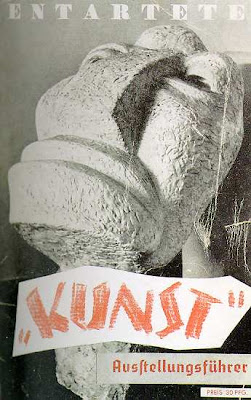
Cubierta de la guía para la muestra ENTARTETE KUNST (Múnich, 1937), donde se ilustra una obra del escultor expresionista Otto Freundlich titulada Der neue Mensch (El hombre nuevo, 1912). Nótese el empleo sarcástico de las comillas en la palabra KUNST (arte) y su deliberada omisión en ENTARTETE (degenerado). La obra elegida por los nazis es primitivista y posee una prominente naríz convexa.
Freundlich era un artista hebreo bien integrado en la sociedad alemana.
Imagen cortesía del Deutsches Historisches Museum, Berlín

Entartete Kunst fue el nombre de una exposición itinerante con propósitos propagandísticos organizada por los nazis en Múnich en 1937 y luego en otras tantas ciudades (Berlín, Leipzig, Düsseldorf, Weimar, Halle, Viena y Salzburgo). La muestra incluía 650 obras de arte moderno realizadas por más de cien artistas de vanguardia y entre ellos figuraban Franz Marc, Pablo Picasso, Wassily Kandinsky, Piet Mondrian, Otto Dix, Karl Schmidt-Rottluff, Edvard Munch, Meidner, George Grosz, Oskar Schlemmer, Joan Miró, Ludwig Kirchner, Emil Nolde, Heckel, Lasar Segall, Max Beckmann, Marc Chagall, Jean Metzinger, Laszlo Moholy-Nagy, Kurt Schwitters, Paul Klee, Hofer, El Lissitzky, Oskar Kokoschka, Lovis Corinth y Max Ernst.

Los movimientos condenados por los nazis abarcaban prácticamente todas las corrientes de vanguardia artística de la época: impresionismo, posimpresionismo, fauvismo, expresionismo, cubismo, abstracción, bauhaus, nueva objetividad, pintura metafísica, dadá y surrealismo.

Intencionalmente, las obras de arte moderno fueron exhibidas por los nazis caóticamente y acompañadas ya por citas que las ridiculizaban o comentarios despectivos que introducían al arte moderno como algo absurdo y patológico.[A] Así, obras de vanguardia eran mostradas como si fuesen producto de enfermos mentales o individuos ideológicamente nefastos, quienes según los nazis debían ser extirpados de la sociedad alemana.

Hitler Y Ziegler inspeccionan la muestra, Múnich, 1937.
Pinturas colgadas en estudiado desorden en un panel de la exposición donde los motivos abstractos de Kandinsky con no accidentalmente combinados con una cita de Grosz expresando que es preciso tomar en serio a[l movimiento nihilista] Dadá [que celebraba el Absurdo] ("Nehmen Sie Dada ernst! – Es lohnt sich").

Con ánimos de poner en evidencia la supuesta "degeneración" que implicaba el arte moderno, el programa de la muestra comparaba no pocos retratos ejecutados por artistas modernos con fotografías de individuos enfermos y que padecían patologías impresionantes, extremas e incurables.

Guía nazi de la exposición presentando patologías varias como fuente de inspiración del arte moderno.

Favorito de Hitler, Ziegler introdujo la muestra de arte "degenerado" en 1937 recalcando que "lo que están viendo son los productos enfermos de la locura, la impertinencia y la falta de talento."

La guía de la muestra en su p. 32 ilustra obras de Baumeister, Ernst y Molzahn bajo el título "Estupidez o impertinencia--o ambas--¡llevadas al extremo!"

En Múnich, "Arte Degenerado" fue presentado paralelamente a la "Gran Exposición de Arte Alemán," que celebraba los trabajos oficiales del régimen nazi. Pero ésta última solo fue vistada por menos de la quinta parte de la cantidad total de personas que asistieron a la muestra de arte "degenerado".[3]

Ambas muestras fueron montadas para ser asimiladas fácilmente por un público lego y sus respectivos mensajes eran presentandos como verdad incontestable. Si bien es cierto que, como reza un conocido refrán, "al que no sabe, cualquiera lo engaña" y "al que no tiene, cualquiera lo compra", ante las muestras organizadas por los nazis, muchos de los visitantes no lograron comprender el mensaje ideológico de tales gestos propagandísticos. Curiosamente, tales personas se quedaron en el "me gusta" o "no me gusta", cosa que les impidió captar el real propósito contrapuntual de las muestras. Porque la razón de ser de esas exposiciones no tenía que ver con asunto estético ninguno sino que era una mezcla de panfletarismo tendencioso y promoción partidaria. Se intentaba presentar el arte en términos antagónicos y extremistas, partiendo de un punto de vista crudo y dicotómico. En efecto, la concepción nazi del arte no era simple, era superficial y simplista.

Los trabajos celebrados por los nazis no eran necesariamente siempre malos en su calidad como forma plástica, no. Sin embargo, y más allá de su posible esteticidad, el problema real era que habían sido realizados por artistas del siglo XX quienes (sea como fuere) terminaron por entregarse y someterse completamente a los dictados del régimen nazi, para ajustarse a los dictados del mismo y reflejar en sus trabajos las premisas de dicho partido. Y, el régimen nazi era, como dijimos, autoritario, racista y belicoso. Pero además era discriminatorio y oportunista.

La "gente" representada en los trabajos encomendados por los burócratas del régimen nazi tendía a ser un conjunto de figuras idealizadas en actitudes más o menos heróicas, aunque a veces también ridículas, afectadas y/o presuntuosas. Tales figuras respondían a aquello que los nazis llamaban el "tipo racial" nórdico, es decir, la "raza aria" destinada, según ellos, a imponer su voluntad innata y dominar el mundo, con mano de hierro.

Es precisamente por eso que las muestras preparadas por los nazis no eran realmente "exposiciones de arte" sino verdaderas herramientas de manipulación masiva.

La cuestión no era tanto si existían o no componentes negativos en el arte de posguerra, ya que el arte, cuando es libre, suele reflejar el muy amplio espectro de la condición humana, las experiencias y el sentir de los hombres: lo lindo, lo que no lo es tanto, y lo feo también. Mas la actitud nazi tenía su fundamento en una percepción maniqueísta de la realidad. Es por ello que los nazis acosaban a todo el mundo recalcándole que o se estaba con el régimen y en conformismo pleno o que se estaba contra él y entonces se era un degenerado. Según ellos, las cosas eran o lo uno o lo otro.

Con todo, el arte nunca es forma y forma solamente. Por el contrario, el arte es forma y significado (incluso cuando es abstracto).

"El arte," según Oscar Wilde, "siempre es superficie y símbolo."

En vez de establecer qué debe o no representar un artista, uno tal vez bien podría cuestionarse: ¿de qué sirve la belleza de una obra plástica si su propósito no es otra cosa que el inculcarle al hombre ideas tales como dominar, explotar y exterminar al prójimo?

La cultura nazi, por otra parte, fue una cultura suicida. Fascinada con el orden, el sufrimiento y la muerte, y más allá de su innegable codicia, el fundamento último de ella no era otro que la autodestrucción.

Andreas Paul Weber: Marcha a la tumba

Los trabajos comisionados por los nazis no son entonces obras de arte sino algo así como una droga irresistible para las masas, una que, promoviendo la uniformidad, intenta volverlas dóciles y obedientes, para finalmente manipularlas y destruirlas.

¿Qué es el conformismo?

Lamentablemente el inapropiadamente denominado "arte nazi" de arte tiene poco y nada. Los trabajos comisionados por el régimen totalitario de los nazis suelen caracterizarse por ser mediocres y sensibleros: propaganda ordinaria, que como tal no puede sino recurrir insistentemente a tipos fijos, o sea, estereotipos.

Entre quienes tuvieron la valentía de oponerse al régimen nazi, mención especial merece el alemán John Heartfield.

John Heartfield: Paz y Fascismo. El fotomontaje muestra la paloma de la paz atravesada por la bayoneta del autoritarismo.

Epílogo

"Tipo" no es arte. Los nazis intentaron abordar mediante su política la cuestión del "tipo" y ello tuvo secuelas importantes. Al hacerlo no sólo se equivocaron, sino que además hicieron mucho daño. Para los líderes nazis, el arte de su tiempo era "degenerado" mas debía llegar a ser un arte reducido a los mínimos elementos estéticos posibles y lograr además conducir al espectador hacia una lectura lineal y unívoca. El líder máximo nazi redujo como nadie el asunto en cuestión al proclamar en uno de sus discursos que "ser alemán es ser claro" y con ello sugirió que el arte alemán también debía ser claro (Círio Simon).[4]

Lo mismo es válido para la propaganda nazi que adoctrinaba las masas haciendo uso "tipos" rotundamente estereotipados.

Antídotos para todo tipo legible y unívoco son el cuestionarse y la dialéctica. Preguntémonos entonces: ¿con qué propósito se buscan perpetuar determinados estereotipos? Es más, ¿a quién beneficia ello? y ¿en qué específicamente?

Las mito-formas de los nazis fueron absorbidas por la estética del kitsch.

En el arte no existe lo correcto o lo equivocado [...] En lo concerniente a los caminos del arte, lo importante es el hábito de asumir el deber de la integridad intelectual.[5]

La humanidad hoy: raza de mil colores

Notas
1. Previamente Max Nordau tomó el término Entartung del campo de la biología y lo aplicó a sus escritos. En su discurso de Nürenberg en 1934, Hitler ya incluye la expresión "arte degenerado" al referirse al arte moderno. Luego organizará una serie de exposiciones paródicas con obras de arte moderno y destinadas a ridiculizarlo. Entre ellas merece mencionarse la de Stuttgart, a la que denominó Kunst in Dienste der Zersetzung, es decir, "Arte al servicio de la desmoralización".
2. Entre los artistas cuyas obras fueron expoliadas y luego desaparecieron especial mención merecen Manet, Monet, Pissarro, Renoir, Van Gogh, Gauguin, Cézanne, Matisse, Picasso, Modigliani, Braque, De Chirico, Chagall, Kirchner, Grosz, Klee y Kandinsky.
3. "La naturaleza vista por mentes enfermas" o "Un insulto para la mujer alemana" eran algunas de las leyendas presentes en la muestra; otras denunciaban la anarquía, el judeo-bolcheviquismo, etc.
4. Según los datos oficiales de los nazis, 400.000 personas se presentaron a la muestra de arte "alemán" y 2.000.000 a la de arte "degenerado". La muestra de "arte alemán" se componía de trabajos "racialmente puros" y que idealizaban tanto la vida campesina como los soldados listos para combatir en la guerra.
5. Tipo não é arte, 2011: "O nazismo tentou, na sua política, colocar em pauta a questão do "tipo" com as mais amplas projeções culturais. Não só errou, mas fez muito mal. [...] Para os líderes nazistas a Arte do seu tempo era "degenerada" [... mas] deveria ser [... Arte] reduzida aos elementos estéticos mínimos possíveis, e, melhor ainda, se ela fosse direcionada para uma leitura linear e unívoca. O seu líder máximo [...] reduziu [o asunto] afirmando que "ser alemão é ser claro", dando a entender que a Arte alemã também deveria ser clara".
6. Círio Simon, Isto não é arte, 2010: "Em arte não existe o certo ou o errado. [...] O importante em relação aos caminhos da arte é o hábito de assumir o dever da integridade intelectual").

Recursos Online
Antología de obras de arte "degenerado" y Commons
Degenerate Art y Degenerate Art Exhibition
The Censure of Democracy
Werckmeister, Totalitarian Art, Northwestern, 1999
Neil Levi, "Judge for Yourselves!" - The "Degenerate Art" Exhibition as Political Spectacle, October, Vol. 85, 1998, pp. 41-64; The MIT Press
El "arte degenerado" de Hitler es ahora la sensación cultural de Berlín, Clarín, 2004
Rachael Bell, Nazi Looted Europe's Great Art Treasures, Crime Library, c. 2011


Ver también:
1
2
3
4
5
6
7
8