17.2.12

O Afflicted One...


Mariano Akerman, Jerusalem, 1992

O afflicted one, storm-tossed, and not comforted,
Behold, I will set your stones in antimony,
And your foundations I will lay in sapphires.

Isaiah 54:11

David Roberts, Jerusalem, 1839
Rembrandt, The Sacrifice of Isaac, 1655
The Western Wall and tho Mosque of Omar, photograph, 1978
Boris Shatz, The Ark of Covenant, 1924
Shmuel Katz, Jerusalem and its Walls, 1975
King David, Gaza Synagogue mosaic, 550 CE
Seal of Ma'adana, 7th century BCE
Luca Giordano, Solomon's Dream, 1693-4
Fergusson, Solomon's Temple, conjectural reconstruction
Temple Implements, Perpignan Bible, 1299
Nicolas Poussin, Judgement of Solomon, 1648
Raphael, The Expulsion of Heliodorus from the Temple, Vatican fresco, 1511-12
Ark of the Law and Ritual Objects, Beth Alpha Synagogue mosaic, 550 CE
Silver Hanukkah lamp, Central Europe, 1830
Avi Yonah, Model of Herod's Temple, c. 1970s
After Michelangelo, The Purification of the Temple, 16th century
Simone Martini, The Bearing of the Cross, 14th century
El Greco, The Crucifixion, 16th century
Raphael, The Resurrection, 1501-2
Jerusalem, Santa Maria Maggiore mosaic, Rome, 450
Andrea del Sarto, Sacrifice of Isaac, 1528
The Dome of the Rock, Jerusalem, photographs
Anonymous, Sacrifice of Isaac, Egyptian mural
The Ark of the Law, Roman glass, 4th century
Ecclesia et Synagoga, Liebfrauenkirche sculptures, Trier, 1250
Jean-Leon Gerome, The Wailing Wall, 1870
Anna Ticho, Judaean Desert, 1970
Rafi Peled, Lions' Parade, Jerusalem, 2002
R.B. Kitaj, Arabs & Jews (Jerusalem), 1985
Dead Sea Manuscripts: The Great Isaiah Scroll, Qumran, 125 BCE
Marc Chagall, Peace, mosaic detail
Mariano Akerman, Jerusalem, 1992

The Foundation Stone, also known as "Navel of the World"
Hebrew, English, German, Russian, Farsi, Turkish, Indonesian

Reference

Solomon 1 2
The Dream of Solomon at Gibeon, by Luca Giordano, 1693. The painting is a depiction of the passage from the Bible, I Kings 3:5-15, in which God appeared to the young king. In the dream God asks Solomon what gift he wanted and Solomon responded that he wanted understanding so that he could properly judge the people. The Neapolitan Giordano produced this painting in Spain when he was about fifty-nine years old. He had just entered the service of the Spanish king. He became wealthy in that service and returned to Naples in 1702 where he died three years later. The painting is 361 cm wide and 245 cm high and is in the Museo del Prado in Madrid.
Raphael, The Judgement of Solomon, 1510-11. Fresco, 120 x 105 cm. Stanza della Segnatura, Palazzi Pontifici, Vatican

9.2.12

Structures of Consciousness


Richard Nickel, Ornament, 2008

THE ELEMENTS OF ARCHITECTURE
Oscar Maisonave's Differentiation

1. Structural


Le Corbusier, Ville Savoie, Poissy, France, 1928-31

2. Decorative


Colisseum, Flavian Amphitheater, Rome, 78-80 EC

3. Ornamental


Johann Esaias Nilson, Neues Caffehaus, Augsburg, 1756


THE ELEMENTS OF COMPOSITION
According to Alfonso Corona-Martinez & Liber Vigo

1. Tradition: Beaux-Arts Approach


Latrobe, Bulfinch y Walter, Capitolium, Washington, D.C., 1800-60

2. Innovation: Modern Approach


Ludwig Mies van der Rohe, Farnsworth House, Plano, Illinois, 1950

SEMIOTICS
by Mariano Akerman


Charles Moore, Piazza d'Italia, New Orleans, 1975-79


And silence is made, European beer advertisment, c.2006


Jeffrey Gusky, Of Life and Loss, photograph, Dzialoszyce, Poland, 1996


Marko Mäetamm, Bleeding House #2, oil on canvas, 2004

Resources
Tradition and Innovation
Visual Communication

8.2.12

Sephirot


In Kabbalah, the Sephirot are the ten attributes or emanations through which God created the world and/or manifests.

The Tree of Life, or Etz haChayim (עץ החיים) in Hebrew, is a mystical symbol used in the Kabbalah of esoteric Judaism to describe the path to God and the manner in which he created the world ex nihilo, out of nothing. The Kabbalists developed this concept into a full model of reality, using the tree to depict a map of Creation. The Tree of Life presents ten sephirot. It may correspond to the Tree of Life mentioned in Genesis 2:9.


Portae Lucis: The Wise Man holding the Tree of Life, engraving, Augsburg 1516

Joseph ben Abraham Gikatilla (1248–1305) (Hebrew: יוסף בן אברהם ג'יקטיליה‎, Spanish: Chiquitilla, "The Little One") was a Spanish kabbalist, student of Abraham Abulafia. Born at Medinaceli, Old Castile, Gikatilla was for some time a pupil of the kabbalist Abraham Abulafia, by whom he is highly praised; his kabbalistic knowledge became so profound that he was supposed to be able to work miracles, and on this account was called "Joseph Ba'al ha-Nissim" (the Thaumaturge or literally Master of Miracles; Zacuto, Yuḥasin, p. 224a). Like his master, Gikatilla occupied himself with mystic combinations and transpositions of letters and numbers; indeed, Abulafia considered him as the continuator of his school (Adolf Jellinek, B.H. iii, p. xl). But Gikatilla was not an adversary of philosophy; on the contrary, he tried to reconcile philosophy with kabbalah, declaring that the latter is the foundation of the former. He, however, strove after the higher science, that is, mysticism. His works in general represent a progressive development of philosophical insight into mysticism. His first work shows that he had considerable knowledge of secular sciences, and that he was familiar with the works of Ibn Gabirol, Ibn Ezra, Maimonides, and others. He died at Peñafiel after 1305.

See also:
Kabbalah
Tree of Life
Klippot

30.1.12

Ivory Pomegranate


The Ivory Pomegranate is a thumb-sized decorative object acquired by the Israel Museum. A Hebrew inscription is engraved around the shoulder of the thumb-size pomegranate that reads, "Holy to the priests, (belonging) to the Temple of [Yahwe]h."

Some researchers believe it adorned the High Priest sceptre within the Holy of Holies. They also consider it a genuine artifact proving the existence of Solomon's Temple.

The Ivory Pomegranate is a small ornamental bone object engraved with a short inscription in paleo-Hebrew. The inscription is inscribed in circular fashion along the shoulders of the pomegranate which is the shape of the fruit in blossom stage.

The ivory pomegranate is a priceless Semitic artifact from 13th century BCE and its inscription probably dates from the 8th century BCE.

The pomegranate was popular as a cultic object and was not unique to the worship of Yahweh.

The thumb-sized ivory pomegranate measuring 44 millimetres (1.7 in) in height, bears an ancient Hebrew inscription that reads, depending on the point chosen as the beginning in the circular inscription, "Belonging to the Temple [literally 'house'] of ---h, holy to the priests" or "Sacred donation for the priests of [or 'in'] the Temple [literally 'house'] of ---h".

Inscription on the ivory pomegranate

"[Belonging] to the Temple of [Yahwe]h, consecrated to the priests"

Inscribed Pomegranate from Solomon's Temple
Ivory, 8th century BCE
The Israel Museum, Jerusalem

The thumb-sized pomegranate is believed to be the only existent relic from Solomon's Temple in Jerusalem. Around the shoulder of the pomegranate there is a carefully incised inscription in early Hebrew characters, part of which is broken off, which reads: "qodes kohanim I-beyt [yahwe]h". "Sacred donation for the priests of (in) the House of [Yahwe]h." "House of Yahweh" most probably refers to the Temple in Jerusalem. The pomegranate was Solomon's favorite motif and decorated the capitals of the two freestanding columns at the entrance to the Temple in Jerusalem (1 Kings 7:21).

An Amazing Artifact. The tiny ivory pomegranate is an ancient relic and can be seen on display at the Israel Museum in Jerusalem. If you ever visit the museum, just ask for the pomegranate. Everyone knows exactly where it is kept, under high tech surveillance. Postcards and small jewelry items of the pomegranate are available in the museum store. A little booklet accompanies the jewelry with the following inscription: "This piece of jewelry is an actual-size replica of an ivory pomegranate, dating to the 8th century BCE, probably a remnant from Solomon’s Temple in Jerusalem, the only existing artifact from the First Temple known to us today. The ancient Hebrew inscription reads: Belonging to the Temple of (Yahveh) Holy to the Priests." (Discovery News, 2006).

Prof. Roman's Conclusions, 2008. An Israeli scientist employed by the defense in the Jerusalem forgery trial has concluded that the inscription on the famous ivory pomegranate ("[Belonging] to the Temple of [Yahwe]h, consecrated to the priests") is authentic.
If the inscription is authentic, the pomegranate is probably the only surviving artifact from Solomon’s Temple.
Professor Yitzhak Roman of the Hebrew University examined the pomegranate under a Scanning Electron Microscope (SEM) to reach his conclusions. In the 1990s he was the academic director of Hebrew University’s SEM.
A committee led by Tel Aviv University’s Yuval Goren had previously concluded that the inscription was a forgery because three critical letters adjacent to an ancient break stopped before the break. The forger was apparently fearful of breaking off more of the pomegranate if he went too close to this fracture. The pomegranate itself is admittedly genuine. However, Professor Roman’s examination showed that the three critical letters, contrary to Yuval Goren’s finding, did in fact go into the ancient break.
This was the same conclusion reached by an examination of the pomegranate at the Israel Museum sponsored by the Biblical Archaeology Society on May 3, 2007: The three letters clearly go into the break.
In addition, Professor Roman examined the patina inside the letters of the inscription. The committee that found the inscription to be a forgery had concluded that this patina was somehow glued into the surviving letters of the inscription. Professor Roman found 11 different elements (some just trace amounts) in the natural patina. But he found no evidence that the patina had been glued (Anchor Stone International, 2009).

The ivory pomegranate was discovered in 1979 by André Lemaire. Many scholars believe the ivory pomegranate is the only artifact that survived from Solomon’s temple (first temple period). The inscription, which was partially destroyed, reads “Holy to the priests, belonging to the Temple of Yahweh.” It currently resides in the Israel Museum.
The ivory pomegranate came under fire as a forgery. The collector who owned them, Oded Golan, was indicted on forgery charges. The trial lasted ten years and the court determined that the Israeli Antiquities Authority had not proved that the artifacts were forged. To the contrary, many famous scholars have already given their stamp of authenticity to the pomegranate (Biblical Archaeology, 2012).

References
André Lemaire, "Une inscription paleo-hebraique sur grenade en ivoire," Revue Biblique, Vol. 88, pp. 236-239.
_____. "Probable Head of Priestly Scepter from Solomon’s Temple Surfaces in Jerusalem," Biblical Archaeology Review, January-February 1984
Don D. Srail, Pomegranate or Almond Bud, 19.1.1997
Is This Inscription Fake?, Biblical Archaeology Review, September-October 2007
Yitzhak Roman, Text on a Pomegranate, Case no. 482/04, District Court, Jerusalem: Expert's Opinion, The Institute for Technology and Forensic Consulting Ltd., 10.12.2008
"Leading Israeli Scientist Declares Pomegranate Inscription Authentic", Biblical Archaeology Review, 16 December 2008; repr. Anchor Stone International, 23 April 2009
"The Ivory Pomegranate, Artifact from Solomon’s Temple", Biblical Archaeology, 19 March 2012.

29.1.12

Kuntillet Ajrud


Kuntillet Ajrud is a 9th-8th century BCE site in the northeast part of the Sinai peninsula.[1] It is frequently described as a shrine, but this is not certain.[2]

The site was investigated in 1975-76. The fortress-like main building is divided into two rooms, one large and the other small, both with low benches. Both rooms contained various paintings and inscriptions on the walls and on two large water-jars ("pithoi"), one found in each room. The paintings on the pithoi show various animals, stylised trees, and human figures, some of which may represent gods. They appear to have been done over a fairly considerable period and by several different artists, and do not form coherent scenes. The iconography is entirely Syrian/Phoenician and lacks any connection to the Egyptian models commonly found in Palestinian art.[3]

Ceramic fragment
Kuntillet Ajrud, Negev, 9th century BCE
Motifs painted on a jar known as "Pithos A"

The inscriptions are in a mix of Phoenician and Hebrew script. The unique Hebrew inscriptions can be divided unto several types: inscriptions incised on pottery vessels before, or after, firing; inscriptions incised on the rims of stone bowls; ink inscriptions on wall plaster and, together with drawings, on large pottery vessels. All of these are unique in Iron Age Israel both in quantity and variety.[4] Many are religious in nature, invoking Yahweh, El and Baal, and two include the phrases "Yahweh of Samaria and his Asherah" and "Yahweh of Teman and his Asherah."[5] There is general agreement that Yahweh is being invoked in connection with Samaria (capital of the kingdom of Israel) and Teman (in Edom); this suggests that Yahweh had a temple in Samaria, and raises a question over the relationship between Yahweh and Kaus, the national god of Edom.[6] The "Asherah" is most likely a cultic object, although the relationship of this object (a stylised tree perhaps) to Yahweh and to the goddess Asherah, consort of El, is unclear.[7]

J.A. Emerton, "New Light on Israelite Religion: The Implications of the Inscriptions from Kuntillet Ajrud," Zeitschrift für die Alttestamentliche Wissenschaft Berlin, 1982, vol. 94, no1, pp. 2-20: Kuntillet Ajrud, ca. 50 km au sud de Kadesh-barnea, carrefour de pistes caravanières du Sinaï septentrional. Importance théologique de deux inscriptions sur jarres qui y furent trouvées (cf Z. Meshel, 1979): YHWH smrn wlsrth et YHWH tmn wsrth. Meshel les date d'avant ou d'après 800 av. J.-C. et lit: "YHWH de Samarie et son Ashera" et "YHWH de Teman et son Ashera". L'A. discute la question de syntaxe: la règle "en hébreu biblique un nom propre ne peut être à l'état construit", pour laquelle l'expression YHWH Sevaot fait problème. Les inscriptions de Kuntillet Ajrud confortent la justesse de la traduction classique "YHWH des Armées". L'expression "YHWH de Samarie" vient d'un voyageur originaire de Samarie et évoque le culte de YHWH tel qu'il y était célébré. YHWH de Téman évoque la tradition de YHWH "venu des montagnes d'Edom". Quant à Ashera, dans ces inscriptions, elle est probablement le symbole en bois de la déesse de ce nom, dont l'association avec le culte de YHWH est attestée dans l'AT. Peut-être, dans la religion populaire, pouvait-elle être considérée comme la parêdre de YHWH.

La critique historique et les découvertes épigraphiques et archéologiques des dernières décennies convergent sur le fait qu’on ne peut, à l’époque de la royauté, parler de judaïsme pour décrire les systèmes religieux en Israël et en Juda. Les inscriptions de [...] Kuntillet Ajrud ont confirmé que Yahvé n’était pas un dieu célibataire, mais associé à la déesse Ashérah, [...] comme l’ont suggéré tout récemment Na’aman et Lissovsky de l’université de Tel Aviv.[8]

Some scholars, including William G. Dever, have asserted that the Asherah was worshipped as a consort of Yahweh, until the 6th century BCE, when strict monolatry of Yahweh became prevalent in the wake of the destruction of the temple.[9] However, the consort hypothesis has been subject to debate with numerous scholars publishing disagreement.[10]


Meaning in the Fragment
by Mariano Akerman

The material found at Kuntillet Ajrud should be taken cautiously and perhaps seriously, but only up to a certain point. Israelites kept the Law, but they occasionally had unexpected twists, including plenty of humor too. The area in which the fragments have been found is relatively far from Jerusalem. It is possible that the individual who depicted "YHWH with His Asherah" was in a sense kidding. That individual was of course not an Israelite priest, but possibly a soldier. That individual pressumably knew about Abraham's response to idolatric polytheism, yet was not entirely for it. Significantly, the graffiti of the Kuntillet Ajrud fragment is popular in character and bold in its insinuations. It presents three figures, yet their identity remains unclear. The sitting figure playing the harp looks feminine. The standing ones do not. Moreover, the standing figures appear to have identical male genitalia. Is YHWH blatantly in the nude? And is "Asherah" a woman or a man? According to the fragment inscription, the "Asherah" depicted is YHWH's one. Supposing that YHWH is the big man standing on the left of the fragment, then who is "His Asherah"? One possibility is to consider the figure playing the harp to be Asherah, while YHWH has apparently arrived "home" with His "Closest Friend". Then one gets some kind of triangular relationship, perhaps speaking for a ménage à trois. But, there is also another possibility that may suit better the tongue-in-cheek aims of the certainly not-entirely-Jewish individual who represented these three Kuntillet Ajrud figures: in the fragment, the figure depicted as the closest to YHWH has been provided with male genitalia and this suggests that "His Asherah" is a male. Thus, the Kuntillet Ajrud fragment can be a provocation testing the very foundations of what opportunely was to become the Abrahamic Nation, whose Singular Being it considers but also mocks in various levels. Concerning the Asherah in the Kuntillet fragment, a popular saying may come to one's mind, "If your grandpa were not a man, he would have been your grandma." Although given the specific genitals of the Kuntillet figure depicted by the side of YHWH, another saying, which is undoubtedly vulgar, may fit this case better: "If your grandma had balls, she'd be your grandpa."[11] Significantly, even if objecting any of these possibilities, one should keep in mind that the Kuntillet Ajrud framgment is probably an early, paleo-Hebrew expression of a strong desire that was going to reappear among some Israelites again and again. Such desire will eventually find expression in terms of paradoxical humor much later, as for example in the double-edged Yiddish holding that if eating pork, one should do it thoroughly.[12]

THE KUNTILLET AJRUD BRIEF-CASE: AS KOSHER AS IT GETS

Notes
1. Robert Karl Gnuse, No Other Gods: Emergent Monotheism in Israel, Sheffield: Sheffield Academic Press, 1997, pp. 69-70
2. Judith M. Hadley, The Cult of Asherah in Ancient Israel and Judah: Evidence for a Hebrew Goddess, Cambridge, UK: University of Cambridge Press, 2000, pp. 108ff
3. Othmar Keel and Christoph Uehlinger, Gods, Goddesses, and Images of God in Ancient Israel (Göttinnen, Götter und Gottessymbole, 1992), Minneapolis: Fortress Press, 1998, pp. 210ff
4. Ze'ev Meshel, Kuntillet Ajrud: An Iron Age Way-Side Religious Center in Sinai, The Shelvy White Leon Levy for Archaeological Publications, Harvard, 2006 (accessed 20.1.2012).
5. Anthony Bonanno, Archaeology and Fertility Cult in the Ancient Mediterranean, University of Malta, 1986, pp. 238ff
6. Keel and Uehlinger, p. 228
7. Ibid, pp. 232-33
8. Nadav Na’aman and Nurit Lissovsky, "Kuntillet ‘Ajrud, Sacred Trees and the Asherah," Tel Aviv, 35, 2008, pp. 186-208 (Thomas Römer, De nouvelles visions sur les récits bibliques des origines, CDF, Paris, 5.2.2009).
9. William G. Dever, Did God Have A Wife?: Archaeology and Folk Religion in Ancient Israel, Eerdmans, 2005; and Judith Hadley, The Cult of Asherah in Ancient Israel and Judah, pp. 122–136
10. A. Shmuel, "Did God Really Have a Wife?", Biblical Archaeology Review, Vol. 32 (2006), pp. 62–66; Mark S. Smith, The Early History of God, Yahweh and Other Deities in Ancient Israel, Eerdmans, 2002, p. xxxii–xxxvi; John Day, Yahweh and the Gods and Goddesses of Canaan, Sheffield Academic Press, 2002, pp. 50–52; André Lemaire, "Who or What Was Yahweh’s Asherah?," BAR, 10:06, Nov/Dec 1984; Kuntillet ‘Ajrud, Mercer Bible Dictionary, Mercer UP, 1991, pp. 494–494; Othmar Keel, Christoph Uehlinger, Gods, Godesses, and Images of God in Ancient Israel, Fortress Press, 1998, p. 237; J.A. Emerton, "Yahweh and His Asherah": the Goddess or Her Symbol?," Vetus Testamentum, Volume 49, Number 3, 1999 , pp. 315–337(23).
11. For obvious reasons, this saying is sometimes expressed as "If grandma had a beard, she would be a grandpa" (Oyb di bobe volt gehat a bord, volt zi geven a zeyde; YiddishWit.com, #8), but the idea it conveys is ultimately the very same.
12. Ez men est khazer zol rinen ariber der bord (Yiddishisms), "If you eat pork, let it run down your beard"; Az men est khazer, zol es shoyn rinen ibern moyl, "If you're going to eat pork, eat it till your mouth drips" (YiddishWit). Both tongue-in-cheek sayings convey the idea that if one is going to do what's forbidden, at least is supposed to enjoy it to the hilt.

Further discussion
André Lemaire, Date et origine des inscriptions hebraïques et pheniciennes de Kuntillet Ajrud, 1984
Kathryn QannaYahu, Kuntillet Ajrud Inscriptions, Lebtahor, accessed 29.1.2012
Sects and Violence in the Ancient World, 2009-11
Ignatz Bernstein, Ignatz Bernstein, Yidishe Shprikhverter un Redensarten, Warsaw, 1908; repr. Jüdische Sprichwörter und Redensarten (Jewish Proverbs and Sayings), Wiesbaden: Fourier Verlag, 1988
YiddishWit Resources

28.1.12

The Mosaic Experience: Arts and Letters


Khirbet Qeiyafa ostracon, Elah Valley (near Beit Shemesh), 11th century BCE

Solomon's Temple, Jerusalem, 957 BCE

Archaeologists have uncovered many remains of synagogues from over two thousand years ago, including several that were in use before the destruction of the Temple in Jerusalem. Synagogues securely dated to before the destruction of the Temple in Jerusalem include the Migdal Synagogue, the ancient synagogue at Gamla, the synagogue of Capernaum, the Herodium synagogue, the synagogue of Qumran, and the small synagogue at the top of Masada.

Beit She'arim Village, North Galilee, 9th century BCE

Inscribed Pomegranate from Solomon's Temple, ivory, 13th century BCE; inscription dated 8th century BCE. Israel Museum, Jerusalem. It bears the inscription Sacred to the Priest of the House of God (YHWH). It may well be an ornament on the High Priest sceptre within the Holy of Holies, and thus a genuine artifact proving the existence of Solomon's Temple.

Kuntillet Ajrud ceramic motifs, fragment, Negev, 8th century BCE. Motifs painted on a jar known as "Pithos A."

Silver scroll fragment from Ketef Hinnom Tombs, Jerusalem, 7th century BCE. The two silver scrolls found present quotations from the Book of Numbers inscribed into the silver and written in ancient Hebrew characters. Apart from their significance for the actual knowledge of the development of the Hebrew alphabet, the scrolls preserve the earliest known citations of texts also found in the Hebrew Bible and are the earliest examples of confessional statements concerning Yahweh.

Hebrew manuscript. Dead Sea Scrolls, Qumran, 125 BCE. Parchment. The Israel Museum, Jerusalem
The Dead Sea Scrolls are a collection of 972 texts from the Hebrew Bible and extra-biblical documents found between 1947 and 1956 at Khirbet Qumran, on the northwest shore of the Dead Sea, from which they derive their name. The texts are of great religious and historical significance, as they include the oldest known surviving copies of Biblical and extra-biblical documents and preserve evidence of great diversity in late Second Temple Judaism. They are written in Hebrew, Aramaic and Greek, mostly on parchment, but with some written on papyrus. The manuscripts generally date between 150 BCE and 70 CE. The scrolls are traditionally identified with the ancient Jewish sect called the Essenes, and include The Great Isaiah Scroll, The Temple Scroll, The War Scroll, The Community Rule Scroll, and The Commentary on the Habakkuk Scroll.

Delos Synagogue, Greece, 2nd century BCE

King David's mosaic, Marot Village, Galilee, 1st century BCE

Shekel of Israel
Inscription: "Jerusalem the Holy"
silver
First year of the Jewish Revolt against Rome, 66 CE

Jericho Synagogue, Wadi Qelt, 1st century BCE
Gamla Synagogue, Golan Heights, 1st century BCE

Korazim Synagogue, Galilee, 1st century CE [+]

Menorah motif, Ostia Antica Synagogue, Italy, 1st century CE

Sardis Synagogue, Turkey, 2nd century

Kfar Bar'am Synagogue, Galilee, 2nd-3rd century CE

Dura-Europos Synagogue frescoes, Syria, 244 CE
Wheel of Fortune mosaic, Hamat Tiberias Synagogue, 3rd century
Ein Guedi Synagogue mosaic, 3rd century
Susya Synagogue, Judea, 4th century CE
Menorah mosaic, Ma'on Village, Judea, 4th century
Lions of Judea mosaic, Hamat Gader Synagogue, Yarmouk river region, 4th century
Gaza Synagogue mosaic, 4th century

Tzippori: Menorah, lulav, and shofar
Menorah mosaic, Tzippori Synagogue, Upper Galilee, 5th century

The Binding of Isaac and Hebrew Wheel of Fortune mosaic, Beit Alpha Synagogue, Mt Gilboa, 6th century
Menorah mosaic, Maoz-Hayim Synagogue, Beit Shean, 6th century
Menorah mosaic, inscr. "Peace upon Israel," Shalom al Yisrael Synagogue, Jericho, Jordan Valley, 6th century

Katzrin Synagogue, Golan Heights, 6th century

Judæo-Persian Slichah (Jewish Penitential Prayer), written in Hebrew, ink on paper leaf, 8th century CE. Discovered in 1908 in the Dunhuang Mogao Caves of Gansu Province, China. Now held at the Bibliothèque Nationale de France, Paris (Dunhuang Manuscripts, Pelliot hébreu 1).

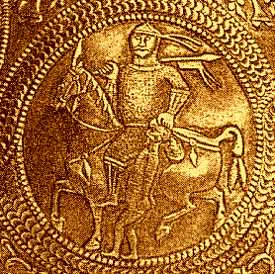
Khazar Warrior with Captive, gold relief, Atil, 850 CE

Aleppo Codex, Hebrew Bible, 930 [+]
Keter Aram Tzova

Shmuel ben Ya'akov, Leningrad Codex, Hebrew Bible, 1008 [+]

Chronology
Paleolithic (Old Stone) Age = 1,500,000-14,000 BCE
Epipaleolithic (Mesolithic, Middle Stone) Age = 14,000-8,000 BCE
Neolithic (New Stone) Age = 8,000-4,500 BCE
Chalcolithic (Copper Stone) Age = 4,500-3,200 BCE
Bronze Age = 3,200-1,200 BCE
Iron Age = 1,200-586 BCE (Biblical Period of the Judges/Israel/Judah)
Babylonian period = 586-539 BCE
Persian period = 539-332 BCE
Hellenistic period = 332-63 BCE
Roman period = 63 BCE-324 CE
Byzantine period = 324-640 CE

Assorted resources

List of Artifacts Significant to the Bible
Ivory Pomegranate
Hebrew manuscripts [+]
Oldest Synagogues in the Land of Israel
Oldest Synagogues in the World
Judaism in Art

Abel Pann, And Sarah Laughed, pastel, 1925

Comparisons
Manuscripts by area
Egyptian papyri
Mawangdui Silk Text, Chinese manuscript, 168 BCE

26.1.12

Abrahamic Nation


Abrahamic religions are the monotheistic faiths trace their common origin to Abraham and recognize a spiritual tradition identified with him. They are one of the three major divisions in comparative religion, along with Indian religions (Dharmic) and East Asian religions (Taoic). As of the early twenty-first century, it was estimated that 54% of the world's population (3.8 billion people) considered themselves adherents of the Abrahamic religions, about 30% of other religions, and 16% of no religion.

The three major Abrahamic religions are, in chronological order of founding, Judaism, Christianity, and Islam. Judaism regards itself as the religion of the descendants of Jacob, a grandson of Abraham. It has a strictly unitary view of God, and the central holy book for almost all branches is the Tanakh (sometimes refered to as the Hebrew Bible), as elucidated in the oral law.
Christianity began as a sect of Judaism in the Mediterranean Basin of the 1st century CE and later became into a separate religion with distinctive beliefs and practices. Jesus is the central figure of Christianity, considered by almost all denominations to be divine, typically as one person of a Triune God. The Christian Bible is usually held to be the ultimate authority, alongside Sacred Tradition in some denominations such as Roman Catholicism and Eastern Orthodoxy.
Islam arose in Arabia in the 7th century CE with a strictly unitary view of God. Muslims (adherents of Islam) typically hold the Qur'an to be the ultimate authority, as revealed and elucidated through the teachings and practices of a central, but not divine, prophet, Muhammad. Less well-known Abrahamic religions, originally offshoots of Shi'a Islam, include the Bahá'í Faith and Druze.

Ephraim Lilien, "Abraham," Die Bucher der Bible, 1908

The three main Abrahamic religions have certain similarities. All are monotheistic, and conceive God to be a transcendent Creator-figure and the source of moral law, and their sacred narratives feature many of the same figures, histories and places in each, although they often present them with different roles, perspectives and meanings. They also have many internal differences based on details of doctrine and practice. Christianity remains divided into three main branches (Catholic, Orthodox and Protestant), dozens of significant denominations, and even more smaller ones. Islam has two main branches (Sunni and Shi'a), each having a number of denominations. Judaism also has a small number of branches, of which the most significant are Orthodox, Conservative and Reform. At times the different religions—and often branches within the same religions—have had bitter conflicts with each other.

It has been suggested that the phrase, "Abrahamic religion", may simply mean that all these religions come from one spiritual source. Christians refer to Abraham as a "father in faith" (Romans 4). There is an Islamic religious term, Millat Ibrahim (The Nation of Abraham), indicating that Islam sees itself as having practices tied to the traditions of Abraham. In addition to Jewish direct birth descendancy from Abraham, adherents follow his practices and ideals as the first of the three spiritual "fathers", Abraham, Isaac, and Jacob.
All the major Abrahamic religions claim a direct lineage to Abraham.
Abraham is recorded in the Torah as the ancestor of the Israelites through his son Isaac, born to Sarah through a promise made in Genesis 17:16. All variants of Judaism through the early 20th century (prophetic, rabbinic, reform, and conservative) were founded by Israelite descendants.
The first part of the Christian Bible is the "Old Testament," which is a modified form of the Jewish Hebrew Bible, leading to the same ancestry claim as above.
It is the Islamic tradition that Muhammad, as an Arab, is descended from Abraham's son Ishmael. Jewish tradition also equates the descendants of Ishmael, "Ishmaelites", with Arabs, as the descendants of Isaac by Jacob named Israel are the "Israelites".
Other terms sometimes used include Abrahamic faiths, Abrahamic traditions, religions of Abraham, Abrahamic monotheistic religions, Semitic religions, Semitic monotheistic religions, and Semitic one god religions.
However, the term "Abrahamic faiths", while helpful, is also misleading. It conveys an unspecified historical and theological commonality that is problematic on closer examination. While there is commonality among the religions, in large measure their shared ancestry is peripheral to their respective foundational beliefs and thus conceals crucial differences. For example, the Christian and Islamic belief in the prophetic position of Jesus is not shared by Judaism; Christian beliefs of Incarnation, Trinity, and Jesus' Resurrection are accepted by nither Judaism nor Islam.

Something in Common: The Centrality of Jerusalem

A view of Jerusalem, not far from the Foundation Stone

Judaism. Jerusalem became Judaism's holiest city in 1005 BCE when David established it as the capital of Israel, and his son Solomon built the First Temple on Mount Moriah. Since the Hebrew Bible relates that Isaac's sacrifice took place there (on the Foundation Stone), Mount Moriah's importance for Jews pre-dates even these prominent events. Jews thrice daily pray in its direction, including in their prayers pleas for the restoration and the rebuilding of the Holy Temple (the Third Temple) on mount Moriah, close the Passover service with the wistful statement "Next year in built Jerusalem," and recall the city in the blessing at the end of each meal. Jerusalem has served as the only capital of all five Jewish states that have existed in Israel since 1400 BC (the United Kingdom of Israel, the Kingdom of Judah, Yehud Medinata, the Hasmonean Kingdom, and modern Israel). It has been majority Jewish since about 1852 and continues through today.
Christianity. Jerusalem was an early center of Christianity. The Pagan Romans under Emperor Vespasian, in order to end the First Jewish Revolt, used forces lead by Vespasian's son and heir to the throne, Titus to lay siege to Jerusalem, sack the city, and destroy the Second Temple in 70 AD (eventually building a shrine to Jupiter Capitolinus in its place). In 135 AD, under Hadrian, as a response to another Jewish revolt against Roman rule (the Third Jewish Revolt of Simon Bar Kochba), the Romans further expelled all Jews from the area, after three revolts in 70 years, to ensure another revolt was not forthcoming. This is when the area surrounding Jerusalem, until then called Roman Judaea, first was given the name "Palestine", or "Syria Palaestina". There has been a continuous Christian presence there since. William R. Kenan, Jr., professor of the history of Christianity at the University of Virginia, Charlottesville, writes that from the middle of the 4th century to the Islamic conquest in the middle of the 7th century, the Roman province of Palestine was a Christian nation with Jerusalem its principal city. According to the Gospel, Jerusalem was the city Jesus was brought to as a child to be presented at the temple (Luke 2:22) and for the feast of the Passover (Luke 2:41). He preached and healed in Jerusalem, unceremoniously drove the money changers in disarray from the Temple there, held the Last Supper in an "upper room" (traditionally the Cenacle) there the night before he is said to have died on the cross, was arrested in Gethsemane. The six parts to Jesus' trial—three stages in a religious court and three stages before a Roman court—were all held in Jerusalem. His crucifixion at Golgotha, his burial nearby (traditionally the Church of the Holy Sepulchre), and his resurrection and ascension and prophecy to return all are said to have occurred or will occur there.
Islam. Jerusalem, the city of David and Christ, became a very holy place to Muslims, like Mecca and Medina. The Al-Aqsa mosque, which translates to "farthest mosque" in sura Al-Isra in the Qur'an, and its surroundings are addressed in the Qur'an as "The Holy Land". Later Muslim tradition as recorded in the ahadith identifies al-Aqsa with a mosque in Jerusalem; nothing in the Qur'an supplies this connection (nor a connection to the Dome of the Rock). The first Muslims did not pray toward Mecca, but toward Jerusalem: the qibla was switched to Mecca as part of a complete break with Judaism, when it became obvious that the Jews would not accept Muhammad as a prophet. Another reason for its significance is its connection with the Miʿrāj, where, according to Muslim tradition, Muhammad ascended through the seven heavens on a winged mule named Buraq, guided by the Archangel Gabriel, beginning from the Foundation Stone on the Temple Mount, in modern times under the Dome of the Rock.

Further discussion
Abraham
Aniconism
Christian Visual Imagery

Abraham smashes the idols